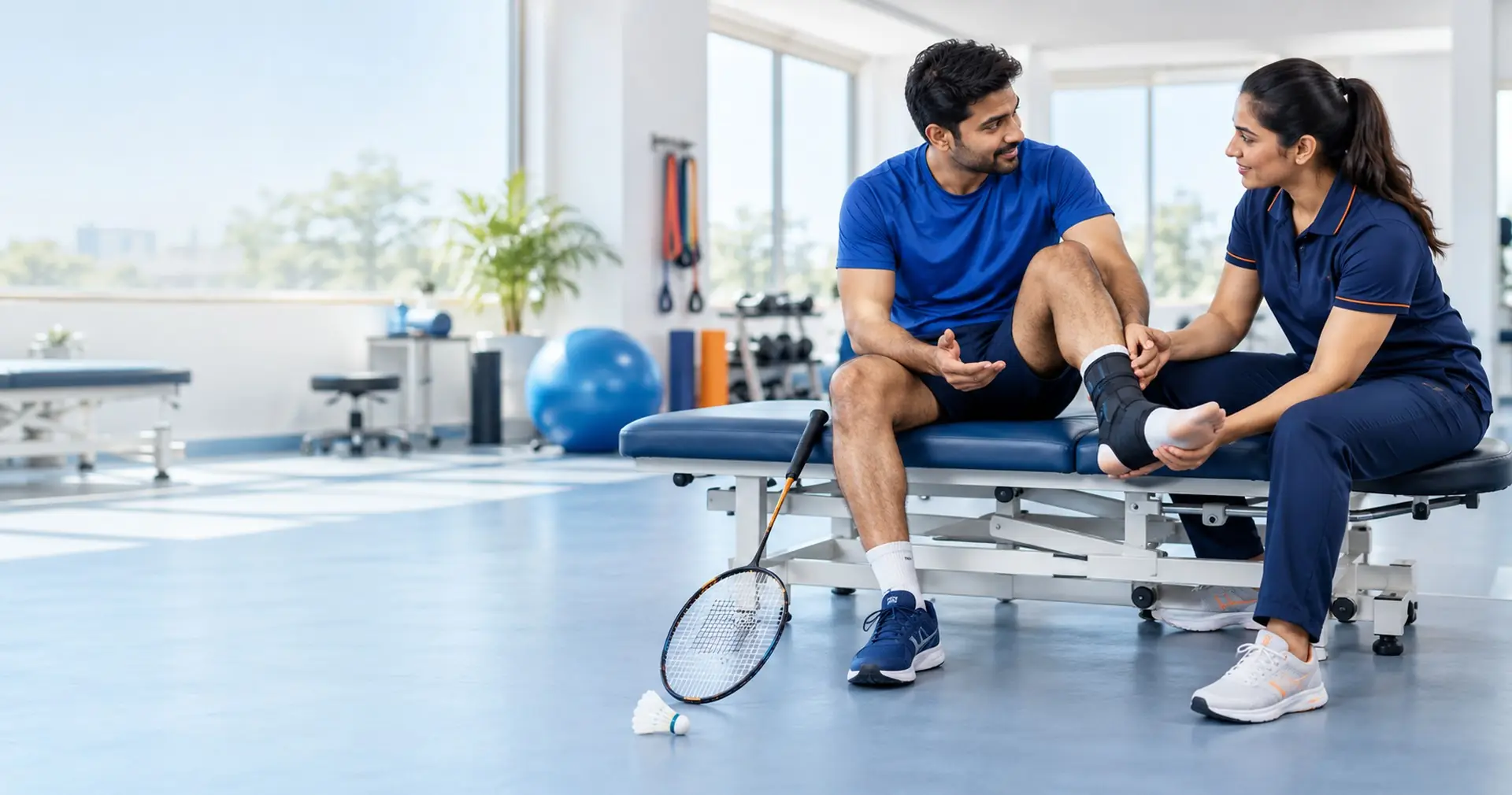
Sports Injury & Arthroscopy care at Sun Hospitals
Body region · Sports Injury & Arthroscopy

Injured playing. Back to playing.

A sports injury has one real question: when can I go back? We treat sprains, strains, bruises and ligament tears, operate by keyhole when needed, and add injury-prevention training for the sport you play.

KeyholeACL · PCL · meniscus · cuff
All-insideACL reconstruction
PreventionSport-specific training
Sports rehabAt both centres

Why treat a sports injury properly?

A sports injury has one real question: when can I go back? The first days set up everything that follows. Rushing back is how a three-week injury becomes a season, and an unstable knee or shoulder that keeps giving way damages its cartilage and meniscus, or its labrum, every time.

So we start with an accurate diagnosis — examination plus a same-visit X-ray or ultrasound, with an MRI when the answer would change your plan — and build a plan around your sport and your season, not a generic printout, including what you can safely keep training while it heals.

Indication

Come in when
  • You heard a pop, and the joint swelled within hours.
  • Your joint gives way, locks or won't take load.
  • An old injury flares every time you train.
  • You're cleared nowhere — and want a real return-to-play answer.
  • You want to go back to sport that involves turning, cutting, landing or contact.

The value of treatment

What treatment gives you
  • A comeback that lasts. Structured rehabilitation — protection first, then progressive loading — takes most sports injuries back to sport without an operation.
  • Where a structure needs fixing, keyhole surgery gives you a joint you can trust: a rebuilt ACL, a repaired meniscus that keeps protecting your knee, a reattached cuff, a stabilised shoulder.
  • A return decided by testing, not the calendar: strength compared side to side, sport-specific movement under fatigue, and confidence — measured, not assumed.
  • Sport typically returns 6–9 months after an ACL reconstruction and from around four to six months after a shoulder stabilisation.
  • Injury-prevention training for the sport you play cuts the risk of the next one.

Who should undergo it

Most sprains, strains, bruises and soft-tissue injuries need rehabilitation, not surgery. Structural injuries are where keyhole surgery earns its place: an ACL rupture in someone who wants to return to pivoting sport, a locked meniscus, a full-thickness cuff tear, a shoulder that keeps dislocating — and in a young athlete in contact sport we may advise stabilising the shoulder even after the first dislocation, because the repeat rate is high.

For most people the surgery is day-care, and we plan your rehab before the operation, not after. Your MRI and our examination decide; if surgery has been advised elsewhere, our second opinion service can look at your case first.

Rehabilitation and surgery: the difference

Both end in the same place: back on the field. The difference is whether a structure in your joint needs fixing first.

How the options differ
  • Structured rehabilitation. Protection first, then progressive loading, with sport-specific work at both our centres. Most sports injuries need this and nothing more.
  • Keyhole repair or reconstruction. All-inside ACL reconstruction, meniscus repair, rotator cuff repair and Bankart repair through cuts of about 5 mm — day-care or a single night for most.
  • Rehab planned before the operation. Your programme is set before you go to theatre, so recovery starts on the day of surgery and follows your surgeon's milestones.
  • Return-to-play testing. You go back when the tests say so — strength side to side, movement under fatigue, confidence — not when the calendar does.
  • What doesn't change. A graft or a repair needs months to heal before it can take load. Physiotherapy is half the operation, and prevention training is how the comeback lasts.

Sports Injury & Arthroscopy treatments at Sun Hospitals

Each treatment in the same format: when we advise it, what it gives you, and what we offer. Every one has its own page.

Sports Physio & Return-to-Play

About this service →
Indication

Most back and neck pain, many knee and shoulder problems, sports injuries and stiffness — often as your first treatment — and the recovery after any operation, fracture or joint replacement.

Value of treatment

A plan that follows your diagnosis and, after surgery, exactly what was done, so the operation counts. Prehab builds strength before; rehabilitation starts early, often the same day, and follows your surgeon's milestones.

What we offer

On-site outpatient and inpatient physiotherapy at both our centres, customised to you and reviewed regularly, with a sports physiotherapy unit at Vidyaranyapura and packages by body part.

ACL Reconstruction

About this procedure →
Indication

A knee that keeps giving way despite physiotherapy, or a torn ACL in someone who wants to return to sport that involves turning, cutting and landing. Not every torn ACL needs it.

Value of surgery

A stable knee you can trust again, and protection for your meniscus and cartilage — an unstable knee damages both over time. Back to sport typically in 6–9 months.

What we offer

All-inside keyhole reconstruction with a graft from your own tendon, fixed into tunnels in your thigh and shin bones — day-care or a single night, walking with support the same day.

Indication

A meniscus tear that causes symptoms — a knee that locks or keeps catching, pain on movement, a sports injury that won't settle — where the tear sits in tissue that can heal.

Value of surgery

A saved meniscus keeps cushioning and steadying your knee for years and lowers your risk of arthritis later. Rehabilitation takes about three months, longer than after trimming — a trade worth making.

What we offer

Keyhole repair with stitches or small anchors, all-inside, inside-out or outside-in as your tear needs, with biological stimulation to help it heal; trimming instead where a tear can't be repaired. Day-care for most.

Rotator Cuff Repair

About this procedure →
Indication

A full-thickness rotator cuff tear — especially after an injury, in younger or active people, or when pain and weakness don't improve with good rehabilitation. Partial and wear-related tears often do well with physiotherapy.

Value of surgery

Less pain, more strength and better movement, and protection against the permanent pain and arthritis a neglected tear can cause. Most people are back to everyday activities after two to three months.

What we offer

Keyhole repair through three to five small cuts: anchors and stitches bring your tendon back to the bone, single-row or double-row depending on the tear, with bone spurs smoothed at the same time.

Indication

A shoulder that dislocates again and again, feels unstable, or has a labral tear that leaves the joint insecure — most often in young, active people and contact-sport athletes.

Value of surgery

A stable shoulder you can trust, less pain in everyday activities, and the control you need for sport and reaching overhead. Sport returns from around four to six months, once testing shows you are ready.

What we offer

Keyhole reattachment of the torn labrum with small anchors and tightening of the stretched capsule, using knotless and all-suture implants — with remplissage or a capsular shift added where needed.

When to come in

See a specialist if
  • You heard a pop, and the joint swelled within hours.
  • Your joint gives way, locks or won't take load.
  • An old injury flares every time you train.
  • You're cleared nowhere — and want a real return-to-play answer.
Bothering you?

Get it looked at properly.