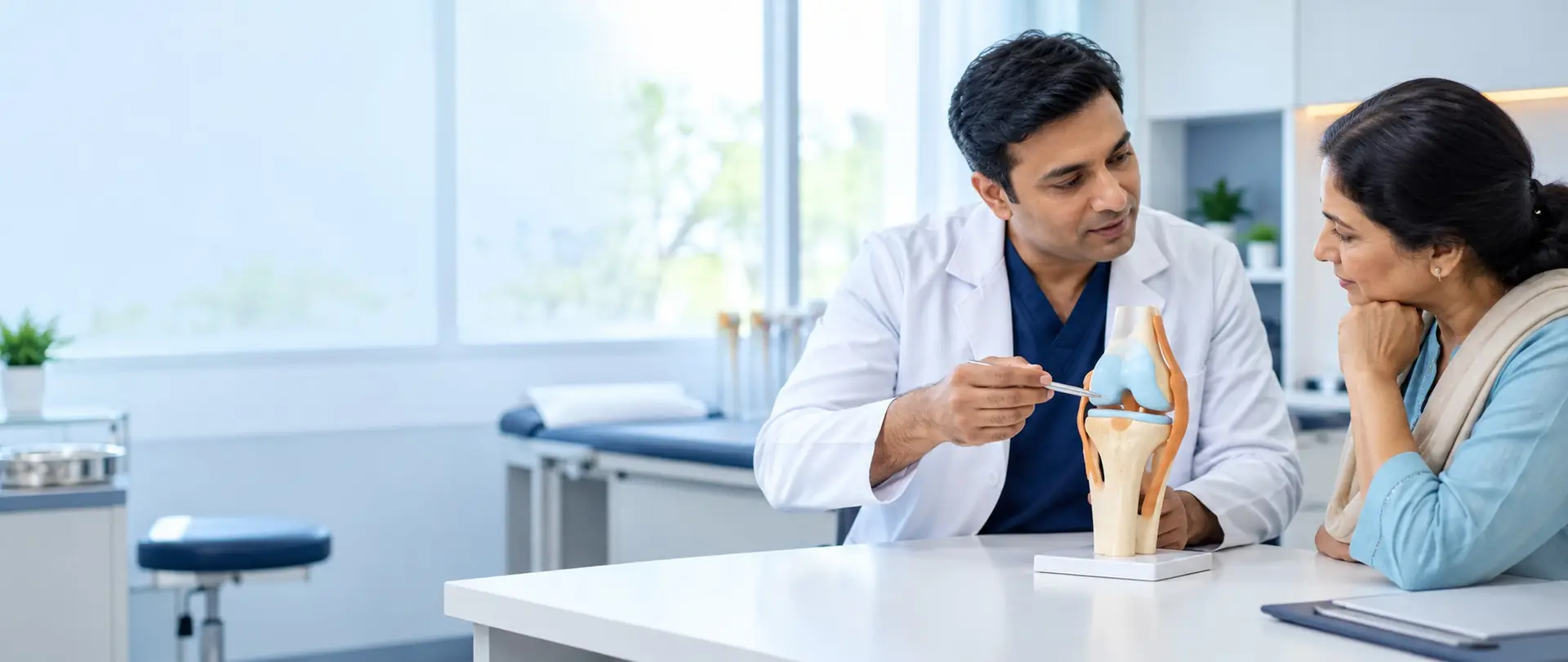
Knee Cartilage Injury & Restoration Surgery in Bangalore
Preserving Joint Surfaces. Restoring Function. Protecting Future Mobility.
What Is a Knee Cartilage Injury?
A Smooth Joint Surface. Essential for Pain-Free Movement.
Articular cartilage is the smooth, protective tissue covering the ends of bones within the knee joint. It allows frictionless movement and helps distribute joint forces.
Cartilage injuries may occur following sports trauma, ligament injuries, kneecap dislocations or repetitive joint loading.
Unlike the meniscus, which acts as a shock absorber, articular cartilage forms the smooth bearing surface of the knee.
What Are the Symptoms of Knee Cartilage Damage?
Pain. Swelling. Difficulty with Movement.
Common symptoms include:
- Knee pain during walking, running or climbing stairs
- Recurrent swelling after physical activity
- Catching, clicking or occasional locking
- Difficulty squatting or performing sports activities
- Restricted knee movement or stiffness
Symptoms vary depending on the location, depth and extent of cartilage damage.
How Is a Knee Cartilage Injury Diagnosed?
Accurate Diagnosis. Identifying the Extent of Joint Damage.
Cartilage injuries are evaluated through a detailed clinical examination and appropriate imaging.
MRI helps identify cartilage defects, their size and depth, underlying bone changes and associated meniscus or ligament injuries.
Weight-bearing X-rays help assess joint alignment and identify degenerative changes.
The findings guide treatment selection and help distinguish focal cartilage injuries from advanced osteoarthritis.
Can Damaged Knee Cartilage Heal Naturally?
Cartilage Has Limited Natural Healing Potential.
Unlike many other tissues, articular cartilage has a limited blood supply and very little ability to regenerate naturally.
Superficial cartilage injuries rarely restore themselves completely. Deeper injuries extending into the underlying bone may produce repair tissue, but this is usually fibrocartilage rather than normal hyaline cartilage.
Early identification and appropriate treatment may help preserve remaining healthy joint surfaces.
Can PRP, Stem Cells or Injections Regrow Damaged Knee Cartilage?
Symptom Relief Is Possible. Reliable Cartilage Regeneration Remains a Challenge.
PRP injections, hyaluronic acid and other non-surgical treatments may provide symptom relief in selected patients.
However, no currently established injection or medicine has been proven to reliably regenerate normal articular cartilage or reverse advanced knee arthritis.
Stem-cell-based therapies remain under investigation, and their long-term effectiveness and safety require further evidence.
Treatment should be based on the type and extent of cartilage damage rather than unproven claims of cartilage regrowth.
Does Every Knee Cartilage Injury Require Surgery?
Not Every Cartilage Defect Needs an Operation.
Small, stable or minimally symptomatic cartilage injuries may be managed through:
- Physiotherapy and muscle strengthening
- Activity modification
- Weight management where appropriate
- Selected medications for symptom relief
- Correction of contributing biomechanical factors
Surgery may be considered when a symptomatic focal cartilage defect persists despite appropriate treatment or causes significant mechanical problems.
Treatment depends on defect size, location, depth, joint alignment, associated injuries and patient activity level.
What Happens if a Cartilage Injury Is Left Untreated?
Persistent Joint Damage May Affect Long-Term Knee Health.
Some small cartilage defects remain stable and cause little difficulty.
However, larger or unstable lesions may produce recurrent swelling, mechanical symptoms and progressive damage to surrounding joint surfaces.
Cartilage injuries associated with ligament instability, meniscus deficiency or abnormal joint alignment may place additional stress on the knee.
Appropriate assessment helps identify patients who may benefit from joint-preserving treatment.
When Is Cartilage Restoration Surgery Recommended?
Preserving the Joint Before Damage Becomes Widespread.
Cartilage restoration surgery may be considered for patients with symptomatic, localised cartilage defects, particularly when surrounding joint surfaces remain relatively healthy.
Potential candidates include younger or active individuals with:
- Focal full-thickness cartilage defects
- Persistent pain or swelling despite rehabilitation
- Osteochondral injuries involving cartilage and underlying bone
- Selected traumatic cartilage lesions
Cartilage restoration procedures are generally less suitable for widespread advanced osteoarthritis.
What Are the Surgical Options for Knee Cartilage Restoration?
Different Defects Require Different Solutions.
Several surgical techniques are available, depending on the size, depth and location of the cartilage injury.
Arthroscopic Chondroplasty
Damaged or unstable cartilage edges are carefully smoothed using arthroscopic instruments.
This may reduce mechanical irritation in selected patients, but it does not regenerate normal cartilage.
Microfracture Surgery
Small openings are created in the underlying bone to stimulate a biological healing response.
This produces fibrocartilage repair tissue and may be considered for selected smaller cartilage defects, particularly in lower-demand patients.
Osteochondral Autograft Transfer (OATS / Mosaicplasty)
Healthy cartilage and underlying bone are transferred from a less weight-bearing area of the patient's own knee to the damaged region.
This technique can restore a localised defect with native hyaline cartilage and supporting bone.
Osteochondral Allograft Transplantation
Cartilage and underlying bone obtained from a screened donor are transplanted into the damaged joint surface.
This may be considered for selected larger osteochondral defects, depending on graft availability and clinical suitability.
Autologous Chondrocyte Implantation (ACI / MACI)
A specialised cartilage restoration technique using the patient's own cartilage cells, which are harvested, cultured and implanted into the damaged region.
It may be considered for selected larger focal defects in suitable patients. Availability varies by centre.
The choice of procedure depends on cartilage defect characteristics, underlying bone condition, patient age and individual functional requirements.
Recovery & Rehabilitation After Cartilage Restoration Surgery
Protecting the Repair. Restoring Strength. Preserving Joint Function.
Rehabilitation plays an essential role in cartilage restoration.
Depending on the procedure, patients may require temporary restrictions on weight-bearing and controlled knee movement to protect the healing or transplanted tissue.
Physiotherapy gradually focuses on:
- Restoring knee range of movement
- Improving muscle strength
- Regaining balance and walking ability
- Progressive functional rehabilitation
- Returning safely to sports and physical activities
Return to demanding sports may take 6–12 months or longer, depending on the procedure, cartilage defect and individual recovery.
Why Choose Dr. Dharmapal G.K. & Sun Hospitals for Knee Cartilage Injuries?
Advanced Arthroscopic Expertise. Joint Preservation. Dedicated Rehabilitation.
With over two decades of orthopaedic surgical experience, Dr. Dharmapal G.K. focuses on arthroscopic knee surgery, sports injuries and personalised joint-preserving treatment.
At Sun Hospitals, our approach combines:
Detailed Cartilage Assessment
Evaluating defect size, location, underlying bone and associated injuries.
Joint-Preserving Philosophy
Preserving healthy cartilage and joint structures whenever clinically appropriate.
Individualised Surgical Planning
Selecting treatments based on clinical findings and patient requirements.
Specialised Orthopaedic Infrastructure
A dedicated 50-bed orthopaedic hospital with three modern operation theatres.
Comprehensive Rehabilitation
In-house physiotherapy services, including home physiotherapy support where appropriate.
Our treatment philosophy focuses on accurate diagnosis, evidence-based treatment decisions, preservation of healthy joint structures and long-term functional recovery.
Our Philosophy: Preserve Cartilage. Protect Joint Health. Restore Confident Movement.
Our team will usually see you within 24–48 hours of your request.
Book an appointment Get a second opinion