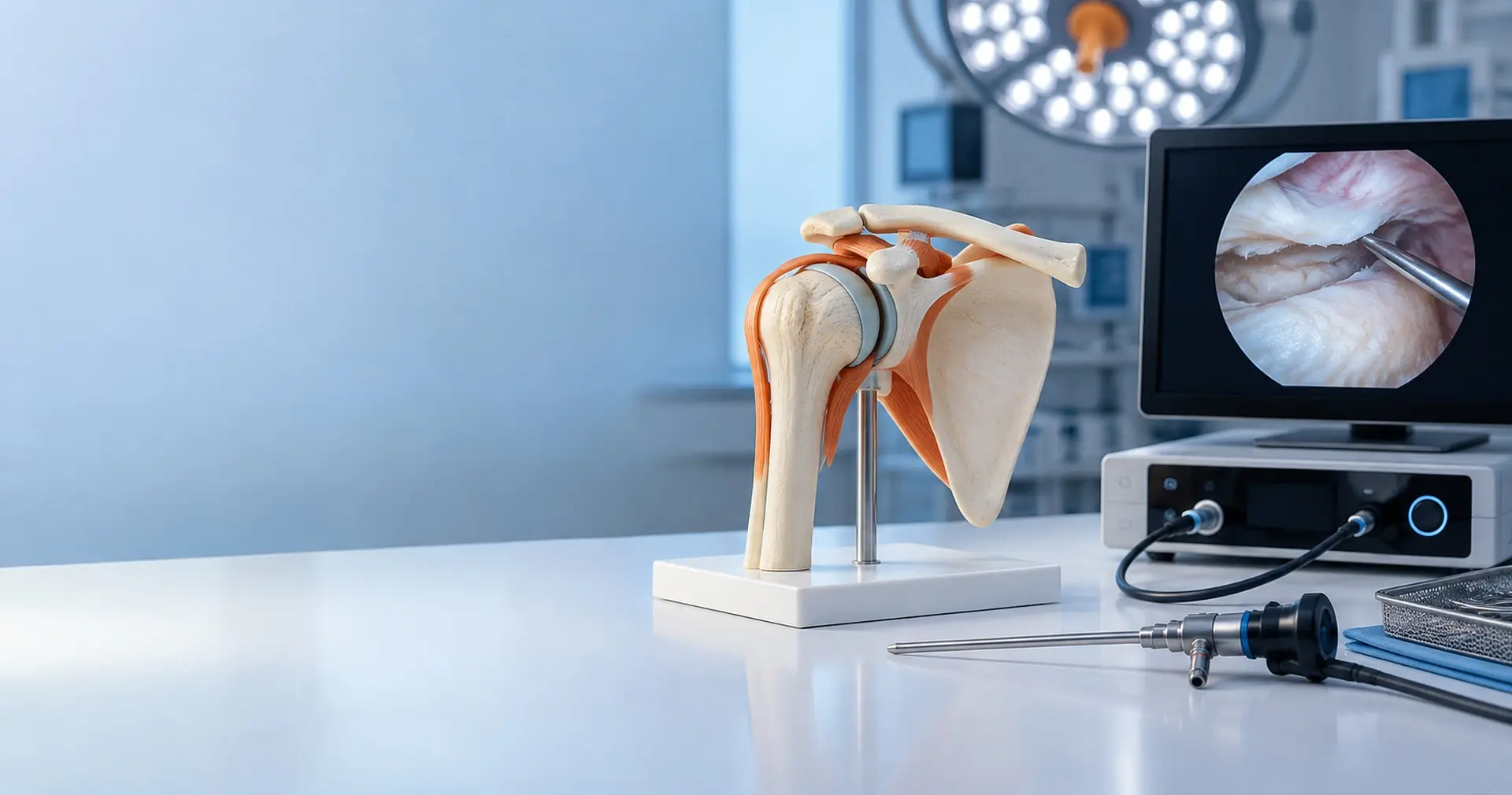
Shoulder Arthroscopy Surgery in Bangalore
Minimally Invasive Surgery. Precision Repair. Restoring Shoulder Function.
What Is Shoulder Arthroscopy?
Small Incisions. Advanced Surgical Techniques.
Shoulder arthroscopy is a minimally invasive surgical procedure that allows the surgeon to examine and treat injuries within and around the shoulder joint using a small camera called an arthroscope.
Through small incisions, specialised instruments are used to repair torn tendons, damaged labrum and ligaments, and treat selected causes of shoulder stiffness.
Compared with traditional open surgery for suitable conditions, arthroscopy generally involves smaller incisions and less disruption of surrounding soft tissues.
What Conditions Can Be Treated with Shoulder Arthroscopy?
Advanced Solutions for Shoulder Injuries and Joint Preservation.
Shoulder arthroscopy is used to treat several tendon, ligament and joint conditions.
Rotator Cuff Tears & Arthroscopic Repair
Repair of torn shoulder tendons using specialised sutures and anchors to restore tendon attachment and improve shoulder function.
Shoulder Instability & Bankart Repair
Arthroscopic repair of the damaged shoulder labrum and supporting ligaments to improve stability in selected patients with recurrent shoulder dislocations.
SLAP Tears & Labral Repair
Treatment of injuries involving the upper shoulder labrum and biceps tendon attachment using arthroscopic repair, debridement or biceps tenodesis, as appropriate.
Frozen Shoulder (Adhesive Capsulitis)
Arthroscopic capsular release may be considered for selected patients with severe, persistent shoulder stiffness that has not responded to appropriate non-surgical treatment.
Shoulder Impingement Syndrome
Most cases of shoulder impingement-related pain are treated without surgery. Arthroscopic treatment may be appropriate when another significant structural condition, such as a symptomatic rotator cuff tear, requires surgical intervention.
When Is Shoulder Arthroscopy Recommended?
The Right Procedure for the Right Shoulder Condition.
Shoulder arthroscopy may be recommended for patients experiencing:
- Symptomatic rotator cuff tears requiring surgical repair
- Recurrent shoulder dislocations caused by suitable labral injuries
- Persistent symptoms from selected SLAP or labral tears
- Severe frozen shoulder unresponsive to appropriate treatment
- Other structural shoulder injuries requiring arthroscopic intervention
Not every shoulder condition requires surgery. Treatment depends on the underlying diagnosis, symptom severity, functional limitations and response to non-surgical care.
Can Shoulder Injuries Be Treated Without Arthroscopy?
Not Every Painful Shoulder Needs Surgery.
Many shoulder conditions improve with physiotherapy, activity modification, strengthening exercises, appropriate medications and selected injections.
Frozen shoulder, shoulder impingement-related pain, many degenerative rotator cuff tears and selected labral injuries can often be managed without surgery.
Our approach prioritises accurate diagnosis and appropriate treatment rather than unnecessary surgical intervention.
How Is Shoulder Arthroscopy Performed?
A Detailed View Inside the Shoulder Through Small Incisions.
During shoulder arthroscopy, the surgeon introduces a miniature camera through a small incision to obtain a magnified view of the joint.
Specialised instruments are inserted through additional small incisions to repair damaged tissues, reconstruct supporting structures or release contracted tissue when necessary.
The procedure is generally performed under anaesthesia, often with regional nerve block techniques for postoperative pain management.
What Are the Advanced Techniques Used in Shoulder Arthroscopy?
Modern Arthroscopic Techniques. Individualised Surgical Repair.
Different surgical techniques are used depending on the condition being treated.
Arthroscopic Rotator Cuff Repair
Torn tendons are reattached to the bone using specialised suture anchors. Single-row, double-row or suture-bridge repair techniques may be selected according to tear characteristics.
Arthroscopic Bankart Repair
The detached shoulder labrum and supporting ligaments are repaired using suture anchors to improve joint stability. Additional procedures may be necessary when significant bone defects are present.
Arthroscopic SLAP Repair & Biceps Tenodesis
Selected superior labral tears may be repaired, while biceps tenodesis may be more appropriate for certain patients with symptomatic biceps-labral injuries.
Arthroscopic Capsular Release
In selected patients with persistent frozen shoulder, contracted portions of the joint capsule are released to improve shoulder mobility.
The surgical technique is selected according to the injury, tissue quality, patient age and functional requirements.
What Are the Benefits of Shoulder Arthroscopy?
Minimally Invasive Treatment. Focused on Restoring Function.
For appropriately selected patients, shoulder arthroscopy offers several potential advantages:
Smaller Incisions
Less disruption of surrounding soft tissues compared with traditional open approaches.
Detailed Visualisation
Magnified assessment of tendons, ligaments and other joint structures.
Targeted Surgical Repair
Precise treatment of damaged shoulder tissues.
Tissue Preservation
Repair of suitable injuries while preserving healthy structures.
Procedure-Specific Recovery
Some procedures permit earlier mobilisation, while complex repairs require longer protection and rehabilitation.
Clinical outcomes depend on the injury, surgical procedure and individual patient factors.
What Are the Risks of Shoulder Arthroscopy?
Minimally Invasive Does Not Mean Risk-Free.
Shoulder arthroscopy is generally considered safe, but potential complications include infection, bleeding, stiffness, blood clots and injury to surrounding nerves or blood vessels.
Tendon and labral repairs also carry procedure-specific risks, including incomplete healing, recurrent tears or persistent instability.
A detailed preoperative assessment helps patients understand the expected benefits, limitations and potential risks.
Recovery & Rehabilitation After Shoulder Arthroscopy
Healing Takes Time. Rehabilitation Restores Function.
Recovery depends on the condition treated and the complexity of the surgical repair.
Following Rotator Cuff Repair
The shoulder is usually protected in a sling for several weeks. Progressive physiotherapy restores mobility and strength, with functional recovery commonly continuing over 4–6 months or longer.
Following Bankart or SLAP Repair
Initial sling protection is followed by gradual mobilisation, strengthening and stability exercises. Return to demanding sports often requires several months.
Following Arthroscopic Capsular Release
Early shoulder movement and supervised physiotherapy are important to maintain the range of motion achieved during surgery.
Successful recovery depends on appropriate tissue healing, adherence to rehabilitation and gradual return to activity.
Why Choose Dr. Dharmapal G.K. & Sun Hospitals for Shoulder Arthroscopy?
Extensive Arthroscopic Experience. Advanced Surgical Infrastructure. Dedicated Rehabilitation.
With over two decades of orthopaedic surgical experience, Dr. Dharmapal G.K. focuses on arthroscopic shoulder surgery, sports injuries and complex shoulder conditions.
Sun Hospitals' institutional experience includes 3,000+ Shoulder Surgeries, reflecting its longstanding involvement in shoulder and orthopaedic care.
Our specialised infrastructure includes:
- 50-Bed Dedicated Orthopaedic Hospital in North Bengaluru
- Three Modern Operation Theatres equipped for advanced orthopaedic procedures
- Advanced Arthroscopic Surgical Techniques for rotator cuff, labral and shoulder instability procedures
- Experienced Orthopaedic Team comprising five orthopaedic surgeons, supported by trained nursing and paramedical professionals
- Comprehensive Physiotherapy & Rehabilitation, including home physiotherapy services
Our treatment philosophy focuses on accurate diagnosis, evidence-based treatment, preservation of healthy shoulder structures and individualised rehabilitation.
Our Philosophy: Restore Stability. Preserve Shoulder Function. Rebuild Confidence in Movement.
Our team will usually see you within 24–48 hours of your request.
Book an appointment Call the front desk