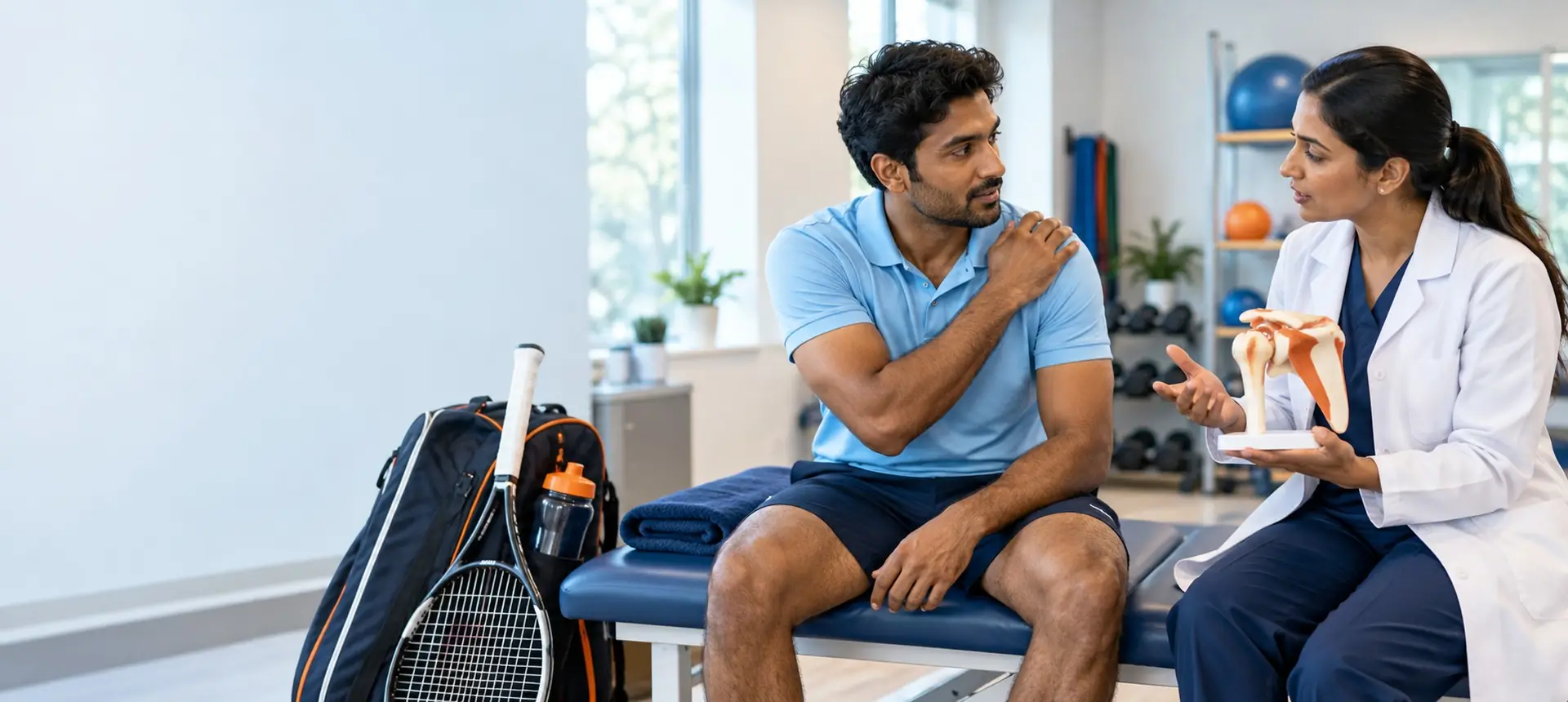
SLAP Tear Treatment & Arthroscopic Shoulder Surgery in Bangalore
Restoring Shoulder Function. Relieving Pain. Rebuilding Confidence in Movement.
What Is a SLAP Tear?
A Small Labral Injury. A Significant Impact on Shoulder Function.
A SLAP tear (Superior Labrum Anterior to Posterior) is an injury involving the upper portion of the shoulder labrum, a ring of fibrocartilage that helps stabilise the shoulder joint.
The injury commonly involves the attachment of the long head of the biceps tendon and may result from falls, sudden pulling injuries, repetitive overhead movements or sports activities.
What Are the Symptoms of a SLAP Tear?
Deep Shoulder Pain. Clicking. Difficulty with Overhead Activities.
Common symptoms include:
- Deep-seated shoulder pain, particularly during overhead movements
- Painful clicking, catching or popping sensations
- Difficulty lifting or carrying objects
- Reduced shoulder strength and endurance
- Pain during throwing or repetitive overhead activities
- Occasionally, a feeling of shoulder instability
Symptoms may overlap with rotator cuff and biceps tendon disorders.
How Is a SLAP Tear Diagnosed?
Accurate Diagnosis. Identifying the True Source of Shoulder Pain.
Diagnosis involves a detailed clinical examination, assessment of shoulder movement and specialised tests evaluating the labrum and biceps tendon.
MRI or MR Arthrography can help identify superior labral tears and associated shoulder injuries.
However, labral abnormalities may also be present in individuals without shoulder pain, particularly with increasing age.
Treatment decisions should be based on clinical findings and symptoms, not MRI results alone.
Can a SLAP Tear Heal Naturally Without Surgery?
Symptoms Can Improve, Even Without Anatomical Healing.
A detached superior labral tear has limited potential to heal back to its original attachment naturally.
However, many patients experience significant improvement in pain and shoulder function through structured rehabilitation and strengthening of the surrounding muscles.
Important: PRP and other injections have not been proven to reliably reattach a torn shoulder labrum. Selected injections may help relieve symptoms but are not substitutes for surgical repair when it is indicated.
Does Every SLAP Tear Require Surgery?
Not Every SLAP Tear Needs an Operation.
Many SLAP injuries can be managed successfully with:
- Physiotherapy and shoulder strengthening
- Rotator cuff and scapular stabilisation exercises
- Activity modification
- Appropriate pain-relieving medications
- Selected injections for symptom relief
Surgery may be considered when persistent pain, mechanical symptoms or functional limitations remain despite an appropriate course of rehabilitation.
The decision depends on the tear pattern, patient age, sporting requirements and associated shoulder conditions.
What Happens if a SLAP Tear Is Left Untreated?
Persistent Symptoms May Affect Shoulder Function.
Some SLAP tears remain stable and cause minimal or no symptoms, particularly when associated with age-related labral degeneration.
However, symptomatic tears may lead to:
- Persistent deep shoulder pain
- Painful clicking or catching
- Difficulty with throwing and overhead movements
- Reduced sporting performance
- Ongoing biceps-related shoulder discomfort
A SLAP tear does not inevitably progress to significant joint damage. Treatment is guided by symptoms, function and associated injuries.
When Is Arthroscopic SLAP Surgery Recommended?
Treating Persistent Symptoms. Restoring Functional Shoulder Stability.
Arthroscopic surgery may be recommended when a clinically significant SLAP tear causes persistent symptoms despite appropriate non-surgical treatment.
Surgical treatment may be considered in:
- Young, active patients with unstable traumatic SLAP tears
- Overhead athletes with continuing pain and functional limitations
- Patients with persistent mechanical symptoms
- Selected patients with associated biceps tendon pathology
- Patients who have not improved following structured rehabilitation
The aim is to address the symptomatic labral or biceps attachment problem and restore comfortable shoulder function.
What Are the Surgical Options for SLAP Tears?
The Right Procedure Depends on the Tear and the Patient.
Modern shoulder arthroscopy allows surgeons to evaluate the labrum and biceps tendon through small incisions using a camera and specialised instruments.
Treatment varies according to the SLAP tear type, tissue quality, patient age and activity level.
Arthroscopic SLAP Repair
The detached superior labrum is reattached to the shoulder socket using specialised suture anchors.
SLAP repair may be considered in selected younger patients with traumatic labral detachment, particularly when preserving the native biceps-labral attachment is appropriate.
Arthroscopic Biceps Tenodesis
Biceps tenodesis involves releasing the long head of the biceps tendon from its attachment at the superior labrum and securing it to the upper arm bone.
This reduces stress on the damaged labral attachment and may be particularly suitable for patients with degenerative SLAP lesions, biceps tendon pathology or selected failed SLAP repairs.
Arthroscopic Labral Debridement
For selected stable or degenerative labral tears, damaged and unstable tissue may be carefully trimmed using arthroscopic instruments.
This aims to reduce mechanical irritation without unnecessarily repairing tissue that does not require fixation.
Biceps Tenotomy
In selected patients, the long head of the biceps tendon may be released without reattachment to relieve pain arising from the biceps-labral complex.
Potential disadvantages include muscle contour changes, cramping and occasional loss of endurance.
What Are the Benefits and Expected Outcomes of SLAP Surgery?
Reducing Pain. Improving Function. Supporting an Active Lifestyle.
For appropriately selected patients, arthroscopic treatment of SLAP tears aims to:
- Reduce shoulder pain and mechanical symptoms
- Improve functional shoulder movement
- Address symptomatic labral or biceps tendon pathology
- Improve comfort during overhead activities
- Support a gradual return to sports and daily activities
Many patients experience meaningful improvement following surgery and rehabilitation.
However, persistent pain, stiffness, recurrent symptoms and failure to return to the previous sporting level remain possible.
Recovery & Rehabilitation After SLAP Surgery
Protecting Healing Structures. Restoring Movement. Rebuilding Strength.
Recovery depends on whether the patient undergoes SLAP repair, biceps tenodesis or another arthroscopic procedure.
Early Protection (0–6 Weeks)
Following SLAP repair, the shoulder is commonly supported in a sling for approximately 2–6 weeks. Controlled movement is introduced according to the surgical protocol.
Restoring Movement (6–12 Weeks)
Physiotherapy gradually improves shoulder range of motion, muscle control and functional movement. Restrictions on resisted biceps activity depend on the procedure.
Strengthening (3–6 Months)
Progressive strengthening focuses on the rotator cuff, shoulder-blade muscles and functional activities.
Return to Sports (6–9 Months or Longer)
Return to demanding overhead or throwing sports may require 6–9 months or longer, depending on the procedure, strength, shoulder function and sporting requirements. Some patients resume less demanding activities earlier.
Structured rehabilitation is essential for protecting healing tissues and achieving functional recovery.
Why Choose Dr. Dharmapal G.K. & Sun Hospitals for SLAP Tear Treatment?
Extensive Shoulder Surgical Experience. Advanced Arthroscopy. Individualised Rehabilitation.
With over two decades of orthopaedic surgical experience, Dr. Dharmapal G.K. focuses on arthroscopic shoulder surgery, sports injuries and personalised treatment of shoulder disorders.
Sun Hospitals' institutional experience includes 3,000+ Shoulder Surgeries, reflecting its longstanding work in shoulder and orthopaedic care.
Our approach combines:
Detailed Shoulder Assessment
Evaluating labral injuries, biceps tendon involvement and associated shoulder conditions.
Individualised Treatment Planning
Selecting between non-surgical care and appropriate arthroscopic procedures based on clinical requirements.
Advanced Arthroscopic Infrastructure
Three modern operation theatres within a dedicated 50-bed orthopaedic hospital.
Experienced Orthopaedic Team
Five orthopaedic surgeons supported by trained nursing and paramedical professionals.
Comprehensive Rehabilitation
In-house physiotherapy services, including home physiotherapy support where appropriate.
Our treatment philosophy focuses on accurate diagnosis, preservation of healthy shoulder structures, appropriate surgical treatment and structured rehabilitation.
Our Philosophy: Relieve Pain. Preserve Shoulder Function. Restore Confident Movement.
Our team will usually see you within 24–48 hours of your request.
Book an appointment Get a second opinion