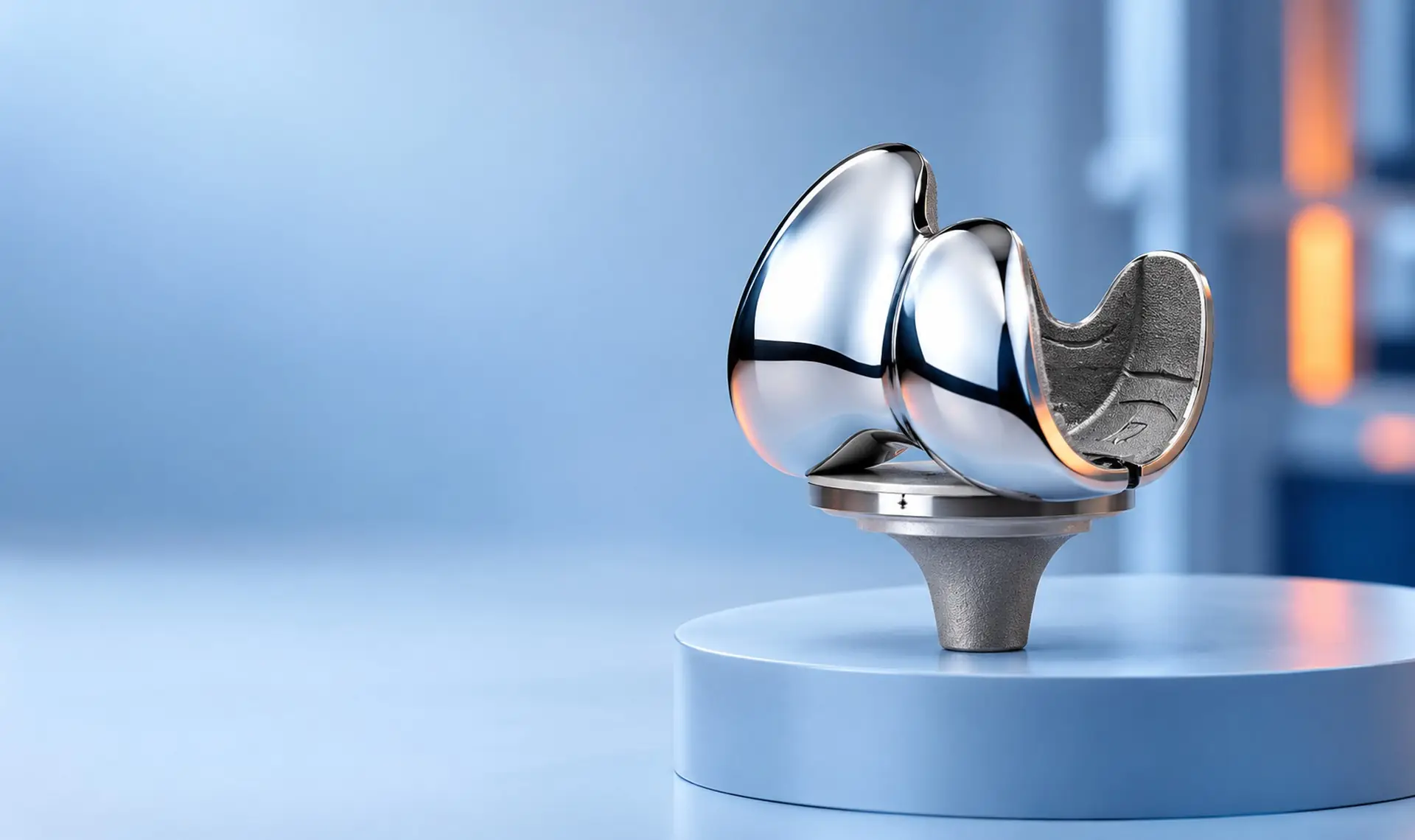
Advanced material. Designed for long-term performance.
An advanced knee replacement is not only about how accurately the implant is positioned — the material and design of the implant matter too. Alongside CORI® robotic-assisted knee replacement, we offer selected knee implant systems featuring OXINIUM oxidised zirconium technology from Smith+Nephew: an implant material engineered to combine the durability of metal with the wear resistance of ceramic, excellent resistance to scratching and surface damage, high corrosion resistance, and virtually no cobalt, nickel or chromium.
What OXINIUM is
OXINIUM stands for oxidised zirconium, an advanced material developed specifically for joint replacement implants. Unlike conventional knee femoral components, which are commonly made from cobalt-chromium alloy, OXINIUM uses a zirconium-based metal that goes through a specialised manufacturing process. That process transforms the outer surface of the material into a hard, ceramic-like oxidised zirconium surface.
The result combines two things: a hard, wear-resistant surface and a strong metal structure underneath — ceramic-like surface properties with the toughness of metal.
It is not a coating. This is an important distinction. OXINIUM is not a ceramic coating applied over a conventional metal implant. During manufacturing, the surface of the zirconium alloy itself is transformed into oxidised zirconium, so the ceramicised surface is integral to the implant material rather than a separately applied layer.
Why the material of a knee implant matters
During normal knee movement, the femoral component moves against a specialised polyethylene insert — millions of times over the life of an implant. The quality of that bearing surface can therefore influence friction, surface scratching, polyethylene wear, the production of wear particles, corrosion and long-term implant performance.
A smoother, harder and more scratch-resistant femoral surface is designed to reduce damage to the polyethylene bearing surface. That is one of the reasons advanced bearing materials such as OXINIUM were developed.
The advantages of OXINIUM knee implants
Here is what the material brings, and where its limits are.
OXINIUM and conventional cobalt-chromium implants
Both cobalt-chromium and OXINIUM are established materials in knee replacement, and both can give you a successful result. OXINIUM offers certain material advantages; the right implant is selected for your individual requirements.
| OXINIUM oxidised zirconium | Conventional cobalt-chromium | |
|---|---|---|
| Implant type | Ceramicised zirconium-based metal | Cobalt-chromium alloy |
| Bearing surface | Oxidised zirconium | Polished metal |
| Wear resistance | High | Established conventional performance |
| Scratch resistance | High | Lower than OXINIUM in laboratory testing |
| Corrosion resistance | High | Established metallic performance |
| Cobalt | Virtually none | Present |
| Nickel | Virtually none | May be present |
| Chromium | Virtually none | Present |
| Ceramic-like surface properties | Yes | No |
| Metal structural characteristics | Yes | Yes |
| Long-term clinical experience | More than 20 years | Extensive |
| CORI® robotic compatibility | With compatible Smith+Nephew knee systems | With compatible implant systems |
Does OXINIUM wear less than cobalt-chromium? Laboratory testing has shown that OXINIUM has greater scratch and abrasion resistance and can reduce polyethylene wear compared with conventional cobalt-chromium bearing surfaces under the tested conditions. That is an important material advantage — but laboratory wear performance should not be read as a guarantee that every OXINIUM knee will last longer than every cobalt-chromium implant. Clinical longevity depends on many patient, implant and surgical factors.
Does OXINIUM mean my knee will last longer? This is one of the most important questions we are asked. The honest answer: OXINIUM is designed to improve wear performance and provide a durable articulating surface, and clinical studies have shown good long-term results. But it is not scientifically appropriate to promise a fixed lifespan, or to guarantee that an OXINIUM knee will always outlast a conventional one. How long any knee replacement lasts depends on your age, activity and weight, the implant design, surgical technique, implant positioning, ligament balance, bone quality, infection and trauma. Our aim is to combine a high-performance implant material with accurate surgery and proper rehabilitation.
CORI® robotics and OXINIUM: precision meets material
One of the advantages of the Smith+Nephew joint replacement ecosystem is that we can combine CORI® robotic-assisted surgery with compatible knee implants featuring OXINIUM. The two address different, complementary aspects of a knee replacement.
CORI® is about how the implant is positioned: patient-specific 3D mapping, alignment assessment, ligament and gap assessment, implant positioning, real-time planning and precision bone preparation. OXINIUM is about what the bearing surface is made of: high wear and scratch resistance, ceramic-like surface properties, metal durability, excellent corrosion resistance, and virtually no cobalt, nickel or chromium. Together they let us combine precision with material science, rather than relying on either alone.
Even the most advanced implant needs the right position, and even precise robotic placement cannot remove every material-related factor that affects long-term performance. So our approach brings together accurate planning, robotic-assisted precision, appropriate ligament balance, advanced implant design, a high-performance OXINIUM bearing surface and structured rehabilitation.
In robotic total knee replacement, CORI® assists your surgeon in planning the implant position and preparing the knee; depending on the implant system and your requirements, an OXINIUM femoral component can then be used. In robotic partial knee replacement, compatible OXINIUM technology is available in Smith+Nephew partial knee systems, so robotic-assisted preparation can be combined with a wear-resistant bearing for appropriately selected people — patient selection remains essential. In revision knee replacement, OXINIUM is available within selected Smith+Nephew revision systems, and CORI® has supported workflows for selected revision procedures; the implant needed depends on bone loss, ligament stability and the reason for the revision.
CORI® robotic knee replacement →Robotic knee replacement →Revision joint replacement →
Who might consider an OXINIUM knee
OXINIUM may be considered for a wide range of knee replacement patients. It is particularly worth discussing if you are relatively young or active, if long-term wear performance is an important consideration for you, if you are having robotic-assisted knee replacement with a compatible implant system, if you have concerns about cobalt, nickel or chromium exposure, or if you need a specific Smith+Nephew primary or revision knee system.
Age alone does not decide the implant, though. Your surgeon selects it according to your anatomy, bone quality, activity level and overall clinical requirements — and after discussing it with you in plain language. Not every patient needs the same implant.
Why we offer CORI® with OXINIUM
Our aim is to combine advanced surgical technology with the appropriate implant technology, in the hands of an experienced joint replacement team.
The choice of implant, and whether robotic-assisted surgery suits you, depend on an individual clinical assessment. Implant materials and robotic technology cannot guarantee a particular outcome or implant lifespan. Your surgeon will recommend the appropriate treatment for your condition.
FAQs
What is an OXINIUM knee?
Is OXINIUM stronger than a conventional knee implant?
Is OXINIUM more durable?
Is OXINIUM better than cobalt-chromium?
Is OXINIUM useful if I have a metal allergy?
Is OXINIUM a ceramic knee?
Is OXINIUM a ceramic coating?
Does OXINIUM contain nickel?
Is OXINIUM suitable for younger patients?
How long has OXINIUM been used?
Is OXINIUM compatible with CORI® robotic knee replacement?
Does robotic surgery make OXINIUM perform better?
Can OXINIUM be used for partial, total or revision knee replacement?
Does OXINIUM guarantee I will never need revision surgery?
Should everyone choose OXINIUM?
Our team will usually see you within 24–48 hours of your request.
Book an appointment Call the front desk