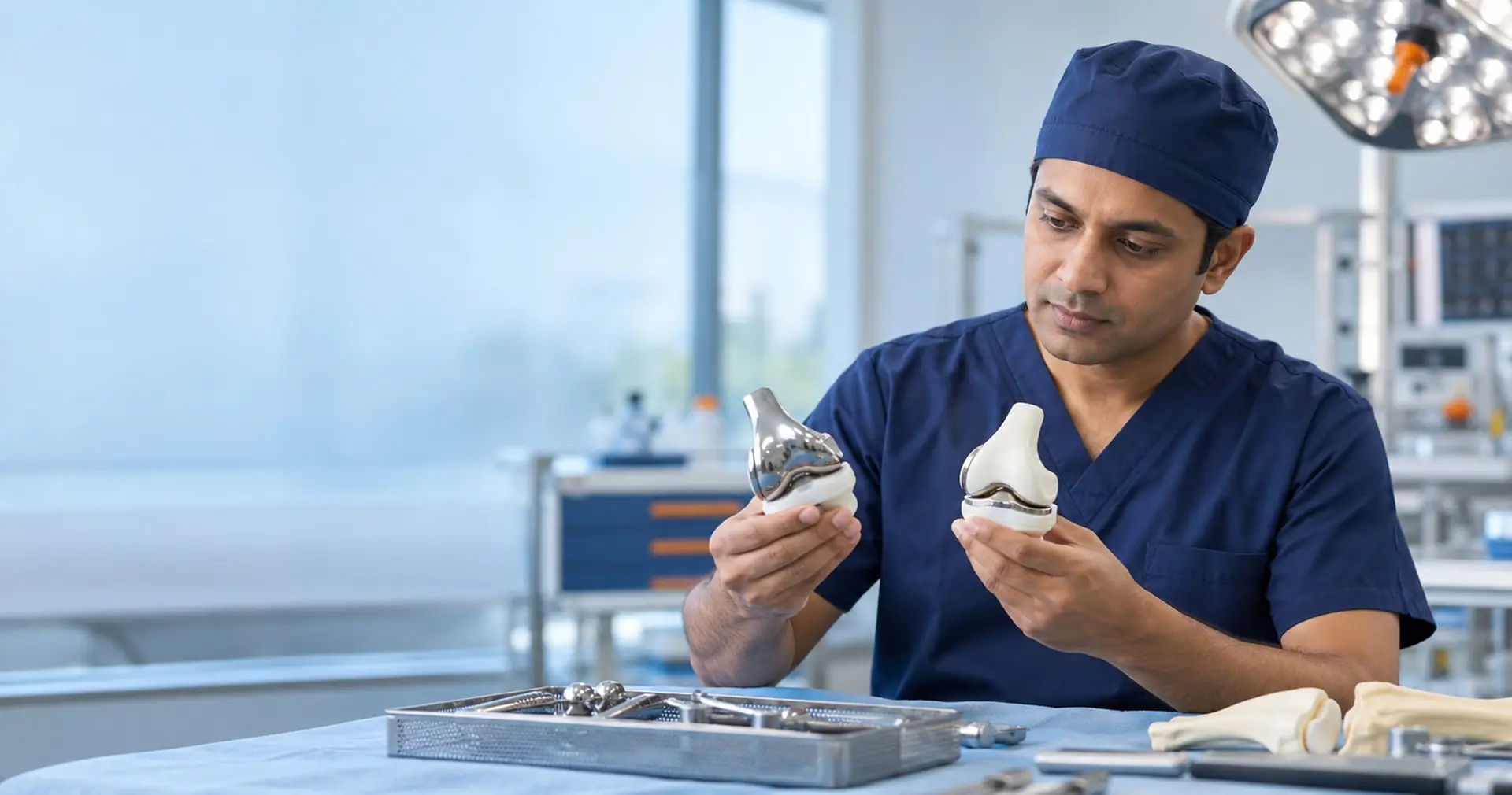
A failed joint replacement is not the end of mobility.
A knee or hip replacement can give you many years of pain relief and mobility. In some people, though, the artificial joint develops a problem over time — loosening, wear, infection, instability or a fracture around the implant. When a previous replacement is no longer working well, a second operation, called revision joint replacement, may be needed. At Sun Hospitals we begin by finding out exactly why the first replacement is causing trouble, then plan the reconstruction around your implant, your bone and your health.
What is revision joint replacement?
Revision joint replacement is an operation to treat a problem with an artificial knee or hip that has already been implanted. It is different from a first-time, or primary, replacement: it often needs more extensive evaluation, detailed surgical planning, specialised implants and careful handling of your bone and soft tissues.
Depending on why your original replacement has failed, your surgeon may need to:
- Replace only one component of the existing implant
- Exchange a polyethylene liner or another component
- Replace several components
- Remove and replace the entire joint replacement
- Treat infection around the implant
- Reconstruct damaged or deficient bone
- Stabilise a fracture around the implant
Some revision procedures are relatively limited; others need extensive reconstruction. What we do depends entirely on the reason your first replacement has failed.
We offer revision total knee replacement, revision total hip replacement, and the management of failed and infected replacements, implant loosening, instability and recurrent dislocation, fractures around implants and bone loss around implants.
Why can a joint replacement need revision?
Artificial joints are designed for long-term function, but problems can occasionally develop — shortly after surgery or many years later. The common reasons are these.
When should you get a previous joint replacement checked?
Come and see us if a knee or hip that has been replaced develops any of the following:
- New or increasing joint pain
- Increasing swelling
- Difficulty walking
- Progressive stiffness
- Joint instability or giving way
- Recurrent hip dislocation
- Clicking or other abnormal mechanical symptoms
- A change in the alignment of your limb
- Sudden pain after a fall
- Inability to bear weight
- Redness or warmth
- Persistent wound discharge
- Fever together with joint symptoms
- Progressive shortening or deformity
New pain in a replacement that was working well should not be put down to normal ageing. We identify the cause before we plan any treatment.
How we evaluate a painful joint replacement
Successful revision surgery begins with identifying why the original replacement is causing problems. Your evaluation with us may include the following.
Revision total knee replacement
We perform a revision total knee replacement when a previously implanted knee needs further surgery because of mechanical failure, infection, instability, fracture or another significant problem. Depending on the cause of failure and the condition of your remaining bone and soft tissues, the operation may replace only the polyethylene insert, one implant component, both the femoral and tibial components, or the complete knee replacement system.
Revision knee surgery may be needed for aseptic implant loosening, infection, knee instability, polyethylene wear, progressive bone loss, a periprosthetic fracture, implant-related mechanical problems, severe stiffness in selected cases, significant implant malposition, or the failure of a previous revision. A painful knee replacement is investigated thoroughly before we recommend revision.
Bone loss. When an implant has become loose or has been in place for many years, the surrounding bone can be damaged or deficient, so revision may need more than simply replacing the original components. Depending on the amount and location of bone loss, the reconstruction may need specialised revision implants and additional methods to restore support. We plan it according to your remaining bone stock, ligament stability, implant fixation, the degree of deformity and your previous surgery.
Stability. Ligament function matters particularly in the knee. If your ligaments can no longer provide enough stability, a standard primary knee implant may not be sufficient, and revision implant systems with different levels of constraint may be needed. We select the implant for your individual knee, not the same design for every revision.
Revision total hip replacement
We perform a revision total hip replacement when part or all of a previous hip replacement needs replacing or reconstructing. It may involve replacing the femoral head or liner, revising the acetabular cup, revising the femoral stem, revising both the socket and the femoral components, treating recurrent dislocation, reconstructing bone loss, treating infection, or managing a fracture around the implant. We plan the operation around the cause of failure and the amount of bone you have left.
Revision hip surgery may be needed for implant loosening, recurrent dislocation, infection, implant wear, osteolysis and bone loss, a periprosthetic fracture, implant migration, mechanical failure, significant component malposition, or the failure of a previous revision. We establish the cause before deciding on the reconstruction.
Recurrent dislocation. Some people experience repeated dislocation after a hip replacement. Your surgeon evaluates the position of the existing implants, the implant design, soft-tissue tension, muscle function, your previous surgery, your bone anatomy, and spine and pelvic factors where relevant. Revision surgery is sometimes needed to improve stability, and the treatment is individualised to the cause.
Bone loss. Loosening, wear, infection or previous surgery can lead to significant loss of bone around the hip, so the reconstruction has to address both the failed implant and the bone available to support the new one. Specialised revision components may be needed depending on the severity and location of the deficiency, and more complex cases need extensive reconstruction.
Partial or complete revision
Not every failed joint replacement needs every component removed.
Revision for an infected joint replacement
Infection around a knee or hip replacement needs specialised management. The treatment depends on how long the infection has been present, the organism, the condition and stability of the implants, the state of your bone and soft tissue, and your overall health. There are three main surgical strategies.
Fractures around a joint replacement
A fracture around a joint replacement is particularly complex because both the fracture and the existing implant have to be evaluated. Treatment depends on whether the implant is still securely fixed: the options are fracture fixation, revision joint replacement, or a combination of fixation and revision reconstruction. Bone quality and the fracture pattern play an important part in the plan.
How revision differs from the first joint replacement
Revision surgery is generally more complex than a primary replacement. The challenges can include previous surgical scars and scar tissue around the joint, the removal of the existing implants, bone loss, altered anatomy, ligament damage, muscle weakness, infection, previous fractures and the need for specialised revision implants.
The operation may therefore need more detailed pre-operative planning, specialised extraction instruments, revision-specific implants, more complex reconstruction, a longer operating time and closer monitoring afterwards. The surgical plan differs considerably from one person to the next.
Preparing for revision surgery
Revision surgery needs careful preparation. Your pre-operative assessment may include blood investigations, ESR and CRP where indicated, joint aspiration when infection must be excluded, X-rays, a CT or other imaging in selected cases, a medical assessment, an anaesthesia evaluation, a review of your previous operative notes and implant information, blood grouping and preparation where appropriate, an assessment of your bone quality, and a physiotherapy evaluation.
Bring your records. If you can, bring your previous and recent X-rays, the discharge summary from your original surgery, the operative notes, implant stickers or implant details, records of any previous infections, culture reports, previous blood tests, and details of any earlier revision procedures. They are valuable for planning.
Getting you ready. Revision joint replacement can be a major operation. Diabetes, hypertension, anaemia, heart disease, kidney disease, respiratory conditions, obesity, poor nutrition, active infections and skin problems all need careful assessment, and optimising them before surgery helps reduce avoidable risks.
After revision surgery
Your care after the operation depends on the complexity of the reconstruction. It may include pain management, antibiotics where indicated, prevention of blood clots, wound and medical monitoring, physiotherapy, assisted mobilisation and muscle-strengthening exercises. Some people can bear weight relatively early; others need temporary restrictions to protect the reconstruction. Your surgeon gives you instructions for your own procedure.
Walking. When and how you walk depends on the type of revision, the implant fixation, your bone quality, whether there was a fracture, the extent of bone reconstruction, your muscle strength and your overall medical condition. You may use a walker, crutches or a walking stick. Unlike a routine primary replacement, some complex revisions need a period of restricted weight-bearing, so please follow your surgeon's specific instructions.
Physiotherapy. Your rehabilitation is individualised. It may focus on safe mobilisation, joint movement, muscle strengthening, gait training, balance, functional independence, stair training, a gradual increase in weight-bearing, prevention of stiffness and a home exercise programme. Recovery may take longer than after a first-time replacement, particularly after complex reconstruction, infection or fracture.
Risks and possible complications
Because revision joint replacement is generally more complex than a primary replacement, the risks can also be greater. Possible complications include infection or recurrent infection, blood clots and pulmonary embolism, bleeding and the need for a blood transfusion, wound-healing problems, nerve or blood-vessel injury, fracture, joint stiffness, persistent pain, implant instability, hip dislocation, implant loosening, further bone loss, a difference in leg length, and the need for additional surgery.
Your specific risk depends on your medical condition and the complexity of the reconstruction. Your surgeon discusses your individual risks and the expected benefits with you before surgery.
Recovery, and why follow-up matters
There is no single recovery timeline for revision surgery. It depends on the reason for the revision, the type of reconstruction, the amount of bone loss, whether there was infection or a fracture, your muscle condition, age, general health, previous operations and how your rehabilitation progresses. A simple component exchange recovers differently from a complex reconstruction with extensive bone loss, so please don't compare your recovery directly with someone who has had a standard first-time replacement.
Keep coming for follow-up as your surgeon advises, even when the joint is working well. Follow-up can pick up implant wear, progressive bone loss, loosening, alignment changes and other mechanical problems — and finding a developing problem early can sometimes allow treatment before extensive damage occurs.
Why come to us for revision joint replacement
Revision surgery calls for an understanding of complex implant, bone and soft-tissue problems. Here is how we approach it.
Revision joint replacement can be challenging, but careful diagnosis and a properly planned reconstruction can address many of the problems that affect a previous knee or hip replacement. This page is general patient education and does not replace an individual consultation: revision procedures vary greatly in complexity, and what we recommend depends on your implant, bone quality, infection status, medical condition and clinical findings.
FAQs
What is revision joint replacement?
Does pain after a joint replacement always mean I need revision surgery?
What are the common reasons for revision?
Is revision surgery more difficult than the first joint replacement?
Will the entire implant need to be removed?
How do you know whether my joint replacement is infected?
Can an infected joint replacement be treated with antibiotics alone?
What is a two-stage revision?
What is a periprosthetic fracture?
Will I need special implants?
When can I walk after revision surgery?
Is recovery longer after revision surgery?
Can a revision joint replacement fail again?
Should I bring records from my previous surgery?
When should I seek urgent assessment?
Our team will usually see you within 24–48 hours of your request.
Book an appointment Call the front desk