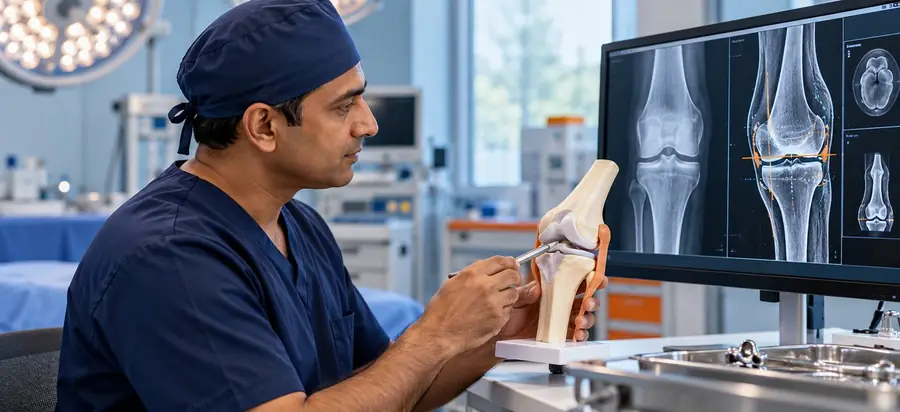
At Sun Hospitals in Bengaluru, we use the CORI® robotic-assisted system from Smith+Nephew for knee replacement. We are often asked about it, and the honest answer is more useful than a sales pitch. In this article we explain what robotic knee replacement is, how CORI® maps your knee, what really changes compared with conventional surgery, who tends to gain the most, where the limits are, and what to ask your surgeon before you decide.
What robotic knee replacement is
A knee replacement resurfaces the worn ends of your thigh bone and shin bone, and often the back of the kneecap, with implants. The aim is to relieve arthritis pain, correct deformity and help you walk, climb stairs and get through the day more comfortably.
"Robotic" can sound as if a machine performs the surgery. It does not. In robotic-assisted knee replacement:
- Your surgeon does the operation. They make every decision and hold the handpiece throughout.
- The system adds measurement and guidance. It builds a digital picture of your knee, helps your surgeon plan where each implant should sit, and guides how much bone is removed.
- It works within limits your surgeon sets. The tool is controlled so that bone is shaped to the agreed plan.
Think of it as a very precise set of measuring and guiding tools in your surgeon's hands, rather than a replacement for their skill and judgement.
How CORI® maps your knee
CORI® uses what is called image-free mapping. This means you usually do not need an extra CT scan before surgery just for the robot. Instead, the mapping happens during the operation.
Here is what that looks like, step by step:
- Registering your knee. Once your knee is exposed, your surgeon uses a tracked pointer to trace the surfaces of your bones. Small markers let the system follow the position of your leg.
- Building a 3D model. From these points, CORI® creates a three-dimensional model of your knee as it is on the day, including the worn areas.
- Checking movement and ligament balance. Your surgeon moves your knee through its range. The system shows how the gaps between the bones behave when your knee is straight and when it is bent. This helps judge how tight or loose the surrounding ligaments are.
- Planning on screen. Your surgeon adjusts the size, angle and position of the implants on the model, in real time, until the balance and alignment look right for your knee.
- Guided bone preparation. A handheld tool then shapes the bone to the plan, under your surgeon's control.
The result is a plan made for your knee, rather than one based only on average measurements.
What changes compared with conventional surgery
Conventional knee replacement is a well-established operation with a long track record. Surgeons use mechanical guides and their own experience to align the implants. Many people have excellent results with it.
Robotic assistance changes some parts of the operation and leaves others the same.
| Conventional knee replacement | Robotic-assisted (CORI®) knee replacement | |
|---|---|---|
| Who operates | Your surgeon | Your surgeon |
| Planning | Based on X-rays, examination and mechanical guides | Adds a live 3D model of your knee made during surgery |
| Ligament balance | Judged by feel and instruments | Also measured and shown on screen |
| Bone preparation | Cutting guides | Guided handheld tool, kept to the plan |
| Implants | Standard implant options | Same families of implants; OXINIUM is one option we offer |
| Rehabilitation | Essential | Just as essential |
| Risks of surgery | Present | Present; robotics does not remove them |
What usually stays the same: the anaesthesia, the type of implant, the need for physiotherapy and the general shape of your recovery. You will usually start walking with support within the first day, depending on how you are, and many people return to routine daily activities over a few weeks, with strength continuing to improve over months. That is true with or without the robot.
Who benefits most
Most people who need a knee replacement can have it done robotically, but some situations make the extra precision especially useful. Your surgeon may lean towards robotic assistance if:
- Your knee is noticeably bowed or knock-kneed. Careful planning helps correct alignment while keeping the soft tissues balanced.
- You may be suitable for a partial knee replacement. When only one part of your knee is worn, precise placement matters a great deal, and the live assessment helps confirm whether partial replacement fits.
- Your ligaments are tight on one side. Being able to see the gaps measured on screen can help your surgeon balance them.
- You are younger and active. You may want a knee that feels as natural as possible for many years of use.
- You have had previous injury or surgery around the knee that has changed its shape.
Equally, if you have straightforward arthritis and your surgeon is very experienced with the conventional method, you may do just as well without the robot. The right choice depends on your knee and your surgeon's assessment, not on the technology alone.
Limits and honest caveats
We would rather you hear the limits from us than discover them later.
- Precision is not the same as outcome. Robotic assistance helps with measurements, alignment and balance. Your result also depends on your overall health, muscle strength, weight, other joints, and how consistently you do your rehabilitation.
- It does not guarantee a faster recovery. Some people do recover quickly; others take longer. Recovery varies from person to person whichever method is used.
- Surgery still carries risks. Infection, blood clots, stiffness, ongoing pain and implant problems can happen after any knee replacement. Your surgeon will talk you through the risks that apply to you.
- It is not right for every knee. In some situations, your surgeon may advise conventional surgery instead.
- The robot cannot replace experience. Good judgement in planning, choosing the implant and handling the soft tissues still comes from your surgeon.
- Physiotherapy is still hard work. The first weeks need effort from you, with support from our physiotherapy team.
If anyone promises that a robot will make your knee perfect, ask them to explain exactly how. A careful surgeon will talk about improved precision, not guaranteed results.
Questions to ask your surgeon
Bring these to your consultation. Write the answers down, or bring a family member to help.
- Do I actually need a knee replacement yet? Have medicines, physiotherapy, weight management and activity changes been tried properly?
- Is my knee suitable for a partial or a total replacement?
- Why do you recommend robotic assistance for my knee in particular? What would be different if you used the conventional method?
- Which implant do you suggest, and why? Ask about the options, including OXINIUM, and how your age and activity level affect the choice.
- What are the main risks for someone with my health?
- What does recovery look like week by week? When can I expect to walk without support, climb stairs, drive and return to work?
- What physiotherapy will I need, and can some of it happen at home?
- What should I do to prepare? Ask about blood sugar, blood pressure, dental checks, medicines and getting your home ready.
A good consultation leaves you feeling informed rather than rushed. It is fine to take time to think, or to get a second opinion.
When to see us
It may be time to talk to a knee specialist if:
- Knee pain is waking you at night or limiting how far you can walk.
- Stairs, sitting cross-legged or getting up from a chair have become hard.
- Your knee is visibly bending inwards or outwards.
- Medicines and physiotherapy no longer give you enough relief.
Our orthopaedic team, led by Dr Dharmapal G K, will examine your knee, review your X-rays and explain all your options, including whether you need surgery at all. You can read more about robotic knee replacement with CORI® at Sun Hospitals, or book an appointment at our Mathikere or Vidyaranyapura centre.
Frequently asked questions
Is robotic knee replacement done by a robot?
No. Your surgeon performs the operation. CORI® helps them map your knee, plan the implant position and shape the bone accurately to that plan. Every decision stays with your surgeon.
Do I need a CT scan for CORI® robotic knee replacement?
Usually not. CORI® is image-free, which means it builds a 3D model of your knee during surgery. You will still need routine X-rays and pre-operative tests, and your surgeon will tell you which ones.
Will I recover faster with a robotic knee replacement?
Some people do, but it is not guaranteed. Recovery depends on your general health, muscle strength, the condition of your knee and how closely you follow your rehabilitation. Robotic assistance improves precision; it does not change the need for steady physiotherapy.
Is robotic knee replacement safe?
It is an established way of doing knee replacement. Like any operation, it carries risks such as infection, blood clots and stiffness. The robot does not remove these risks, and your surgeon will explain how we reduce them for you.
Can everyone have a robotic knee replacement?
Most people who need a knee replacement can, but not everyone. Your surgeon will look at your knee, your X-rays and your health before advising whether robotic or conventional surgery suits you better.
This article is general information and not a substitute for advice from your doctor.