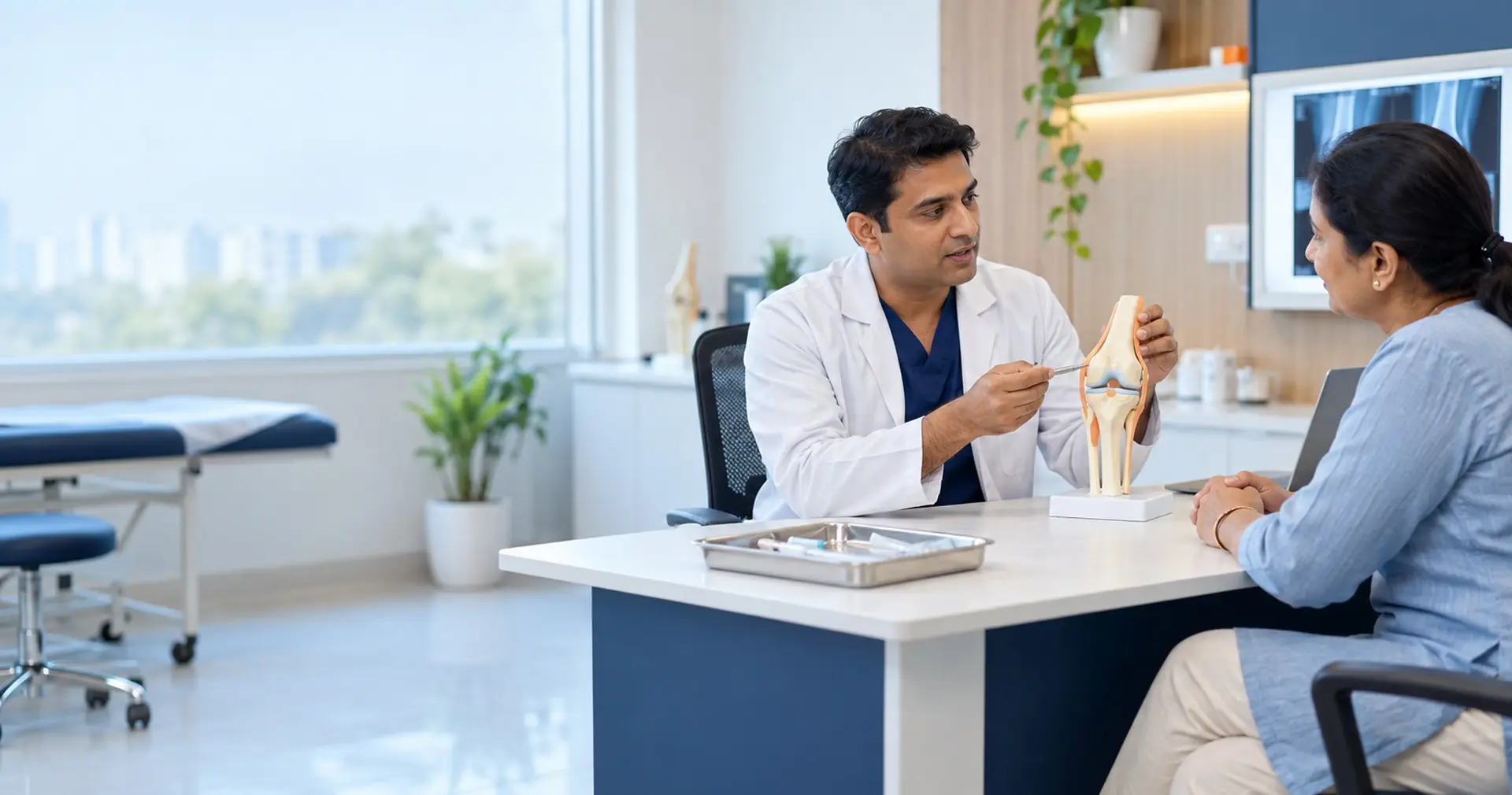
Regenerative Orthopaedics & Orthobiologic Therapy in Bangalore
Supporting Natural Healing. Preserving Joint Health. Advancing Orthopaedic Care.
What Is Regenerative Orthopaedics?
Harnessing Biology. Supporting the Body's Healing Potential.
Regenerative Orthopaedics is an evolving field that explores biological treatments to support tissue healing, relieve symptoms and preserve musculoskeletal function.
These treatments may use substances derived from the patient's blood, bone marrow or other biological sources.
While some orthobiologic treatments have demonstrated benefits in selected conditions, others remain experimental and require further scientific evaluation.
What Conditions May Benefit from Orthobiologic Treatments?
Individualised Treatment for Bone, Joint and Soft-Tissue Conditions.
Orthobiologic treatments are being studied or used selectively for several musculoskeletal conditions, including:
Early Knee Osteoarthritis
Selected injections may help reduce pain and improve joint function.
Tendon Disorders
Certain chronic tendinopathies, including tennis elbow, may benefit from selected biological treatments.
Cartilage Injuries
Focal cartilage defects may benefit from established cartilage repair or restoration procedures.
Sports Injuries
Biological treatments are being investigated as potential adjuncts to ligament and tendon healing.
Bone Healing Disorders
Certain bone grafts and biological materials may support healing in selected difficult fractures.
The effectiveness of treatment varies significantly between conditions.
What Is Platelet-Rich Plasma (PRP) Therapy?
Concentrated Platelets. A Biological Approach to Symptom Management.
Platelet-Rich Plasma (PRP) is prepared from a small sample of the patient's own blood. The sample is processed to concentrate platelets containing growth factors involved in tissue repair processes.
PRP may provide pain relief and functional improvement in selected patients with early-to-moderate knee osteoarthritis and certain chronic tendon conditions.
However, treatment results vary, and PRP has not been proven to reliably regenerate lost joint cartilage or heal complete ligament and tendon tears.
Can Regenerative Injections Regrow Damaged Knee Cartilage?
Symptom Relief Is Possible. Complete Cartilage Regeneration Remains Unproven.
Articular cartilage has limited natural healing capacity, particularly when damage is extensive.
PRP and selected injectable treatments may help improve symptoms in some patients, but they have not been proven to reliably regenerate normal cartilage destroyed by advanced osteoarthritis.
Patients with extensive joint damage may still require established treatments, including joint replacement when clinically appropriate.
The goal is to select treatments supported by evidence rather than make unrealistic promises of cartilage regrowth.
What Is the Role of Stem Cells and Bone Marrow-Based Treatments?
Emerging Science. Ongoing Clinical Research.
Bone Marrow Aspirate Concentrate (BMAC) contains a mixture of cells and biological factors obtained from bone marrow. It is being investigated for selected cartilage and musculoskeletal conditions.
Mesenchymal stem-cell therapies are also an active area of orthopaedic research.
However, the ability of these treatments to reliably restore damaged cartilage, repair established ligament tears or reverse advanced arthritis has not been demonstrated.
In India, stem-cell therapy for orthopaedic conditions remains investigational and should only be undertaken within appropriately approved clinical research.
What Are the Surgical Options for Cartilage Restoration?
Preserving Healthy Joint Surfaces Whenever Possible.
For selected patients with localised cartilage defects, established surgical options may include:
Microfracture
Stimulates a healing response that produces fibrocartilage repair tissue.
Osteochondral Autograft Transfer (OATS)
Transfers healthy cartilage and bone to selected damaged areas.
Osteochondral Allograft Transplantation
Uses donor cartilage and bone for suitable defects.
Autologous Chondrocyte Implantation (ACI/MACI)
Uses cultured cartilage cells to treat selected defects where the technique is available and appropriately authorised.
These procedures differ from injectable regenerative therapies and are generally intended for focal cartilage damage rather than widespread advanced arthritis.
Can Regenerative Orthopaedics Help Avoid Surgery?
The Right Treatment Depends on the Condition, Not the Technology Alone.
Selected orthobiologic treatments may improve symptoms and potentially help postpone surgery in some patients.
However, they cannot reliably correct significant mechanical instability, displaced meniscus tears, advanced joint destruction or severe structural deformities.
Treatment should be guided by clinical examination, imaging, disease severity and the patient's functional requirements.
Not every patient needs surgery. Not every patient benefits from regenerative treatment.
What Are the Benefits, Limitations and Risks?
Promising Possibilities. Evidence-Based Expectations.
Potential benefits of selected orthobiologic treatments include symptom relief, improved function and, in certain applications, support for tissue healing.
However, results vary depending on the diagnosis, biological preparation and individual patient factors.
Possible risks include injection-site pain, swelling, bleeding, infection and failure to achieve meaningful improvement.
Unproven cellular products may carry additional safety and regulatory concerns.
Patients should understand the expected benefits, alternatives and limitations before proceeding.
Recovery and Rehabilitation After Orthobiologic Treatment
Biological Treatments Work Alongside Rehabilitation, Not Instead of It.
Recovery varies according to the condition and treatment performed.
Physiotherapy, gradual strengthening, activity modification and appropriate loading remain important parts of musculoskeletal recovery.
Biological treatments should be considered, where appropriate, as part of a comprehensive treatment plan rather than substitutes for rehabilitation.
Regenerative Orthopaedics & Joint Preservation at Sun Hospitals
Evidence-Based Innovation. Ethical Treatment. Patient-Centred Care.
At Sun Hospitals, our orthopaedic approach focuses on accurate diagnosis, preservation of healthy joint structures and selecting treatments supported by scientific evidence.
Led by Dr. Dharmapal G.K. and supported by specialist orthopaedic and physiotherapy teams, our philosophy emphasises:
Joint Preservation
Maintaining healthy bone, cartilage and soft tissues wherever possible.
Individualised Treatment
Selecting treatment according to clinical findings and patient requirements.
Evidence-Based Decisions
Clearly distinguishing established therapies from experimental treatments.
Comprehensive Rehabilitation
Supporting recovery through structured physiotherapy and functional strengthening.
Our Philosophy: Preserve Where Possible. Repair When Appropriate. Replace Only When Necessary.
Our team will usually see you within 24–48 hours of your request.
Book an appointment Call the front desk