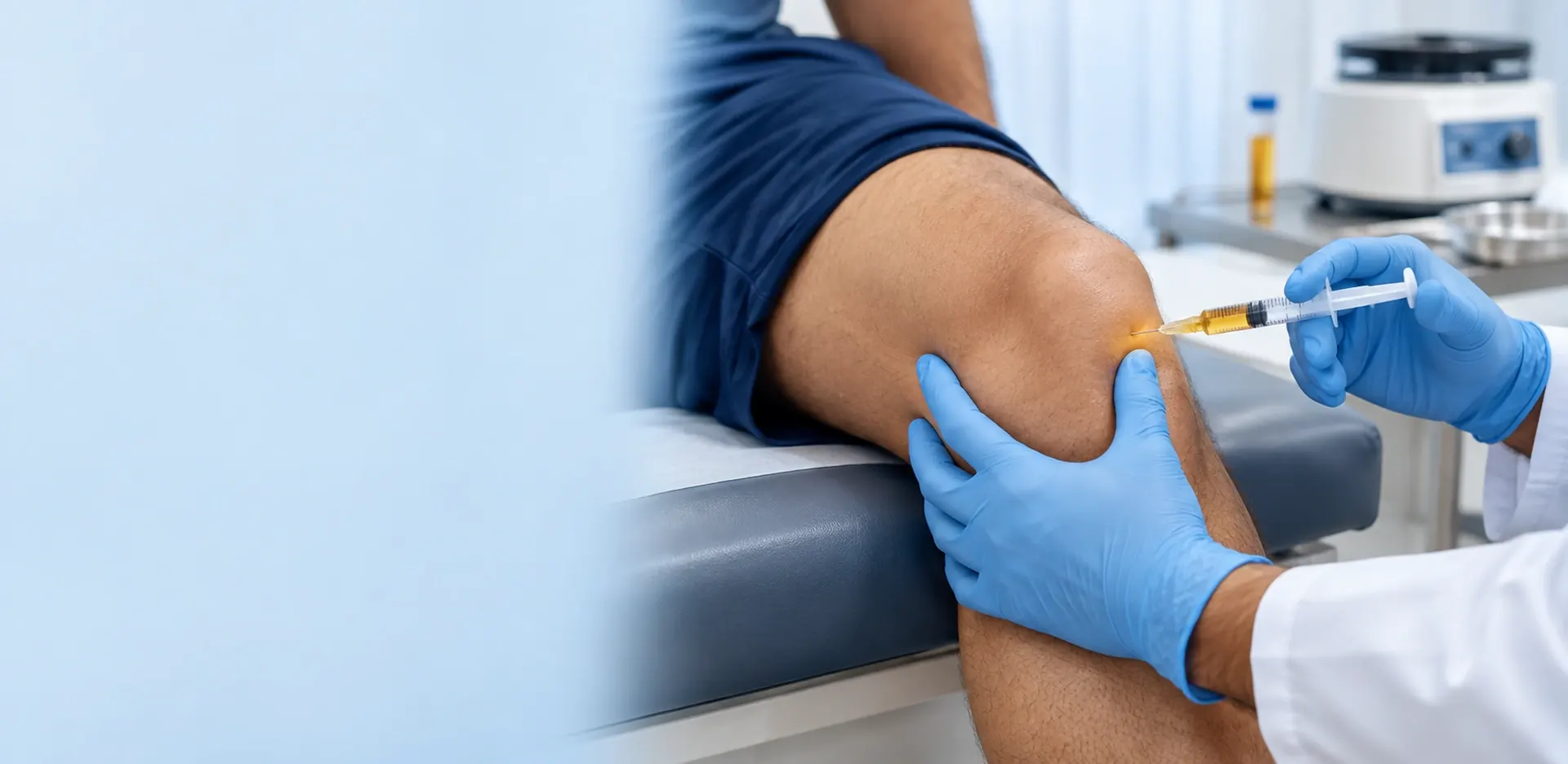
PRP Injection Treatment in Bangalore
Harnessing the Body's Biological Potential. Supporting Joint and Tendon Care.
What Is PRP Therapy?
Your Own Blood. Concentrated Platelets. A Biological Treatment Approach.
Platelet-Rich Plasma (PRP) therapy is an orthobiologic treatment that uses a concentrated preparation of platelets obtained from the patient's own blood.
Platelets contain growth factors involved in the body's natural tissue repair processes.
PRP injections are used selectively in orthopaedics to manage symptoms associated with certain joint and tendon conditions, although their effectiveness varies.
How Is a PRP Injection Prepared and Administered?
A Simple Procedure Using Your Own Blood.
PRP treatment generally involves three steps:
Blood Collection
A small sample of blood is collected from the patient.
Platelet Concentration
The blood is processed using a centrifuge to separate and concentrate platelets.
Targeted Injection
The prepared PRP is injected into the affected joint or soft tissue, sometimes using ultrasound guidance.
The procedure is usually performed on an outpatient basis. The method of preparation and number of injections depend on the condition and treatment protocol.
What Orthopaedic Conditions May Benefit from PRP Injections?
Selected Conditions. Individualised Treatment.
PRP has been investigated for several musculoskeletal conditions.
Knee Osteoarthritis
PRP may offer pain relief and functional improvement in selected patients with symptomatic knee osteoarthritis, although clinical evidence remains mixed.
Tennis Elbow and Chronic Tendinopathy
PRP has been studied for persistent tendon disorders. Some studies report improvement, while others show no meaningful advantage over established treatments.
Rotator Cuff Tendinopathy
PRP has been investigated for chronic shoulder tendon pain. Routine use is not currently supported by major orthopaedic guidelines.
Sports Injuries
PRP is being studied as a biological adjunct in selected ligament, tendon and muscle injuries. However, its ability to accelerate healing or improve long-term outcomes remains uncertain.
Not every painful joint or tendon condition is suitable for PRP treatment.
Can PRP Injections Regrow Damaged Cartilage?
Pain Relief May Be Possible. Cartilage Regeneration Is Not Proven.
PRP may help reduce knee pain and improve function in selected patients with osteoarthritis.
However, PRP injections have not been proven to reliably regenerate lost articular cartilage or reverse advanced knee arthritis.
Patients with severe joint damage, deformity or significant functional limitations may require other established treatments.
Can PRP Heal Torn Ligaments, Meniscus or Rotator Cuff Tendons?
Biological Support Does Not Replace Structural Repair.
PRP injections have not been shown to reliably heal complete ACL or PCL tears, reattach a torn rotator cuff tendon or repair an unstable meniscus tear.
Although research continues into their possible role in tissue healing, PRP should not replace established surgical treatment when mechanical instability or significant structural damage requires repair.
What Are the Potential Benefits and Limitations of PRP Therapy?
A Minimally Invasive Option. Realistic Expectations Matter.
Potential benefits in appropriately selected patients include:
- Reduction in joint pain
- Improvement in functional movement
- Possible symptom relief without immediate surgery
- Use of the patient's own blood-derived preparation
- An outpatient treatment approach
However, treatment response varies, benefits are not guaranteed, and there is no reliable evidence that PRP prevents future joint replacement surgery.
Is PRP Injection Safe?
Careful Patient Selection. Appropriate Clinical Precautions.
Because PRP is prepared from the patient's own blood, the risk of allergic reactions to the injected material is generally low.
Possible side effects include temporary pain, swelling, bruising and, rarely, infection.
Patients with active infection, significant blood disorders or certain medical conditions may not be suitable candidates.
A clinical assessment is necessary before recommending treatment.
What Is the Recovery Process After PRP Injection?
Gradual Recovery. Rehabilitation Remains Important.
Mild discomfort or temporary soreness may occur following PRP injection.
Patients are generally advised to avoid strenuous activity for a short period, depending on the injection site and underlying condition.
A structured rehabilitation programme, including appropriate strengthening and progressive activity, may be recommended.
PRP treatment is not a substitute for exercise, physiotherapy or long-term joint care.
PRP Therapy & Orthobiologic Care at Sun Hospitals
Evidence-Based Treatment. Personalised Care. Ethical Medical Practice.
At Sun Hospitals, our philosophy is centred on preserving healthy joints, selecting appropriate treatment and avoiding unnecessary interventions.
Our orthopaedic approach focuses on:
Accurate Diagnosis
Identifying the underlying cause of joint or tendon pain.
Appropriate Patient Selection
Considering biological treatments only when clinically suitable.
Realistic Expectations
Explaining the potential benefits, limitations and alternatives.
Comprehensive Rehabilitation
Supporting recovery through physiotherapy and strengthening.
Individualised Treatment
Recommending care based on clinical evidence and patient needs.
Our Philosophy: Preserve Where Possible. Repair When Appropriate. Replace Only When Necessary.
Our team will usually see you within 24–48 hours of your request.
Book an appointment Call the front desk