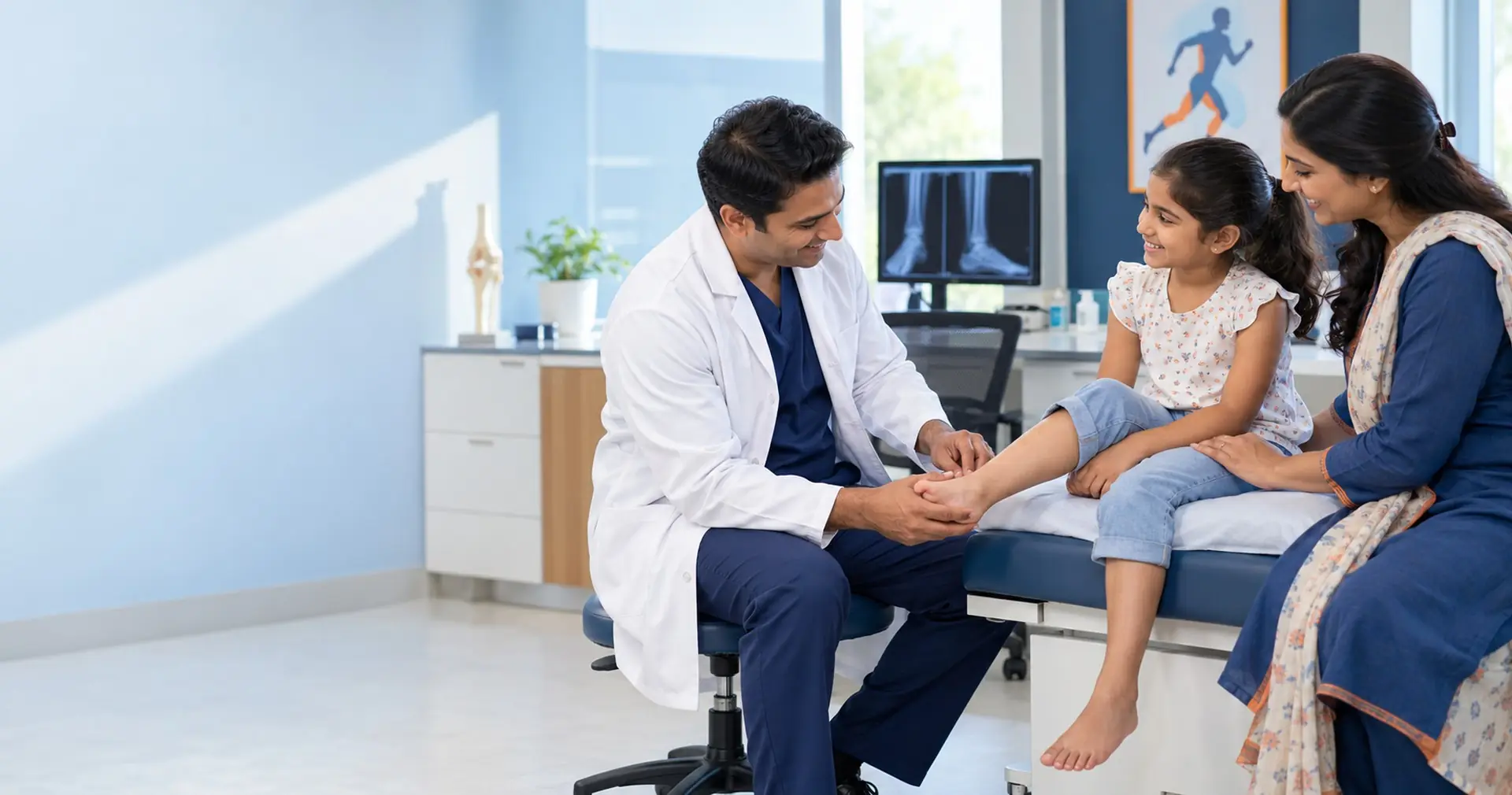
Paediatric Orthopaedics & Children's Bone and Joint Care in Bangalore
Caring for Growing Bones. Supporting Healthy Development. Building Stronger Futures.
What Is Paediatric Orthopaedics?
Growing Bones Need Specialised Attention.
Paediatric Orthopaedics focuses on diagnosing and treating bone, joint, muscle and ligament conditions in infants, children and adolescents.
Unlike adults, children's bones are continuously growing and have unique healing characteristics.
Treatment requires an understanding of growth patterns, developmental changes and the long-term effects of injuries and deformities.
What Are the Common Orthopaedic Conditions in Children?
From Birth-Related Deformities to Growing-Up Injuries.
Common paediatric orthopaedic conditions include:
Developmental Dysplasia of the Hip (DDH)
A condition in which a baby's hip joint does not develop normally, causing instability or displacement of the femoral head from the socket.
Early diagnosis and appropriate treatment, including specialised bracing in suitable infants, can improve hip development.
Clubfoot (CTEV)
A congenital condition in which a baby's foot turns inward and downward.
Early treatment using the Ponseti method, involving serial casting, possible Achilles tenotomy and subsequent bracing, can achieve correction in most children.
Bow Legs & Knock Knees
Variations in lower-limb alignment commonly noticed during childhood.
Many cases improve naturally as children grow. However, persistent, progressive, painful or asymmetric deformities require evaluation.
Flat Feet & Walking Abnormalities
Flexible flat feet, intoeing and out-toeing are common parental concerns.
Many are normal developmental variations that improve with growth. Painful, rigid or progressive abnormalities may require treatment.
Growth Plate Injuries
Children's bones contain growth plates that determine future bone length and shape.
Injuries involving these areas require careful evaluation and follow-up to reduce the risk of growth disturbances or deformity.
Paediatric Fractures & Sports Injuries
Fractures involving the forearm, elbow, wrist, femur, tibia and ankle are common during childhood.
Treatment depends on the child's age, fracture pattern, displacement and remaining growth potential.
Childhood Hip Disorders
Conditions such as Legg-Calvé-Perthes disease and Slipped Capital Femoral Epiphysis (SCFE) can affect hip development and walking ability.
Early recognition is important, especially in children presenting with unexplained limping, hip pain or knee pain.
Limb Length Differences & Developmental Deformities
Differences in limb length, abnormal bone alignment or rotational deformities may require monitoring, growth-guided treatment or corrective surgery in selected cases.
How Can Parents Recognise Orthopaedic Problems in Children?
Early Signs Deserve Attention.
Parents should seek assessment if a child experiences:
- Persistent limping or abnormal walking
- Recurrent joint pain or swelling
- Progressive bowing or deformity of the legs
- Unequal limb length
- Difficulty running, walking or participating in activities
- Restricted joint movement
- Persistent pain following an injury
Important: A child with fever and a painful swollen joint, or sudden inability to bear weight, needs urgent medical evaluation. An adolescent with suspected slipped capital femoral epiphysis should avoid weight-bearing until urgently assessed.
Do All Childhood Bone Deformities Require Treatment?
Not Every Developmental Variation Is a Disease.
Many childhood conditions, including physiological bow legs, flexible flat feet and certain rotational variations, improve naturally as the child grows.
Unnecessary braces, special footwear or surgery are not recommended for normal developmental variations.
However, persistent, painful, asymmetric or progressive deformities may indicate an underlying condition requiring further evaluation.
The goal is to distinguish normal growth from conditions that genuinely require intervention.
How Are Paediatric Orthopaedic Conditions Diagnosed?
Understanding Growth. Identifying Problems Early.
Diagnosis begins with a detailed clinical examination, including assessment of growth, limb alignment, joint movement and walking patterns.
Depending on the condition, investigations may include X-rays, ultrasound or MRI.
Developmental hip disorders in infants may require hip ultrasound, while growth-related deformities may need periodic clinical and radiological monitoring.
Can Paediatric Orthopaedic Conditions Be Treated Without Surgery?
Many Childhood Conditions Respond to Non-Surgical Care.
Depending on the diagnosis, treatment may include:
- Observation and growth monitoring
- Physiotherapy and strengthening exercises
- Plaster casting and specialised bracing
- Activity modification
- Appropriate orthotic support
- Guided rehabilitation
Treatment is individualised according to the child's age, growth potential, symptoms and underlying condition.
When Is Paediatric Orthopaedic Surgery Necessary?
Correcting Deformity. Protecting Growth. Restoring Function.
Surgery may be recommended when significant deformity, joint instability, growth plate damage or complex fractures cannot be adequately managed without intervention.
Procedures may include fracture fixation, selected deformity correction, guided-growth techniques or specialised reconstructive surgery.
The surgical approach is carefully selected to protect growing bones and preserve long-term joint function.
How Are Fractures in Children Different from Adult Fractures?
Growing Bones Heal Differently. Growth Plates Need Protection.
Children's bones have greater remodelling potential, allowing certain fractures to heal successfully with casting or splinting.
However, fractures involving growth plates may affect future bone growth and require specialised assessment.
Displaced or unstable fractures may need surgical fixation, followed by appropriate monitoring to ensure satisfactory healing and continued growth.
Recovery & Rehabilitation in Children
Supporting Healing. Encouraging Safe Movement.
Children often have good healing potential, but recovery depends on the injury or condition being treated.
Rehabilitation may involve restoring joint movement, improving muscle strength, correcting movement patterns and gradually returning to school, play and sports.
Follow-up is particularly important for injuries that may affect future bone growth.
Why Choose Sun Hospitals for Paediatric Orthopaedic Care?
Specialised Orthopaedic Infrastructure. Individualised Treatment. Compassionate Care.
Sun Hospitals is a 50-bed dedicated orthopaedic hospital in North Bengaluru, offering orthopaedic assessment and care supported by modern infrastructure and rehabilitation facilities.
Our infrastructure includes:
- Three Modern Operation Theatres supporting orthopaedic procedures.
- Experienced Orthopaedic Team comprising five orthopaedic surgeons.
- Advanced CSSD supporting surgical instrument sterilisation and infection-prevention practices.
- Dedicated Physiotherapy Services for individualised rehabilitation.
- Trained Nursing and Paramedical Professionals supporting treatment and recovery.
Our approach emphasises timely assessment, appropriate specialist involvement, avoiding unnecessary surgery and supporting healthy musculoskeletal development.
Our Philosophy: Protect Growing Bones. Preserve Healthy Development. Support Active Childhoods.
Our team will usually see you within 24–48 hours of your request.
Book an appointment Call the front desk