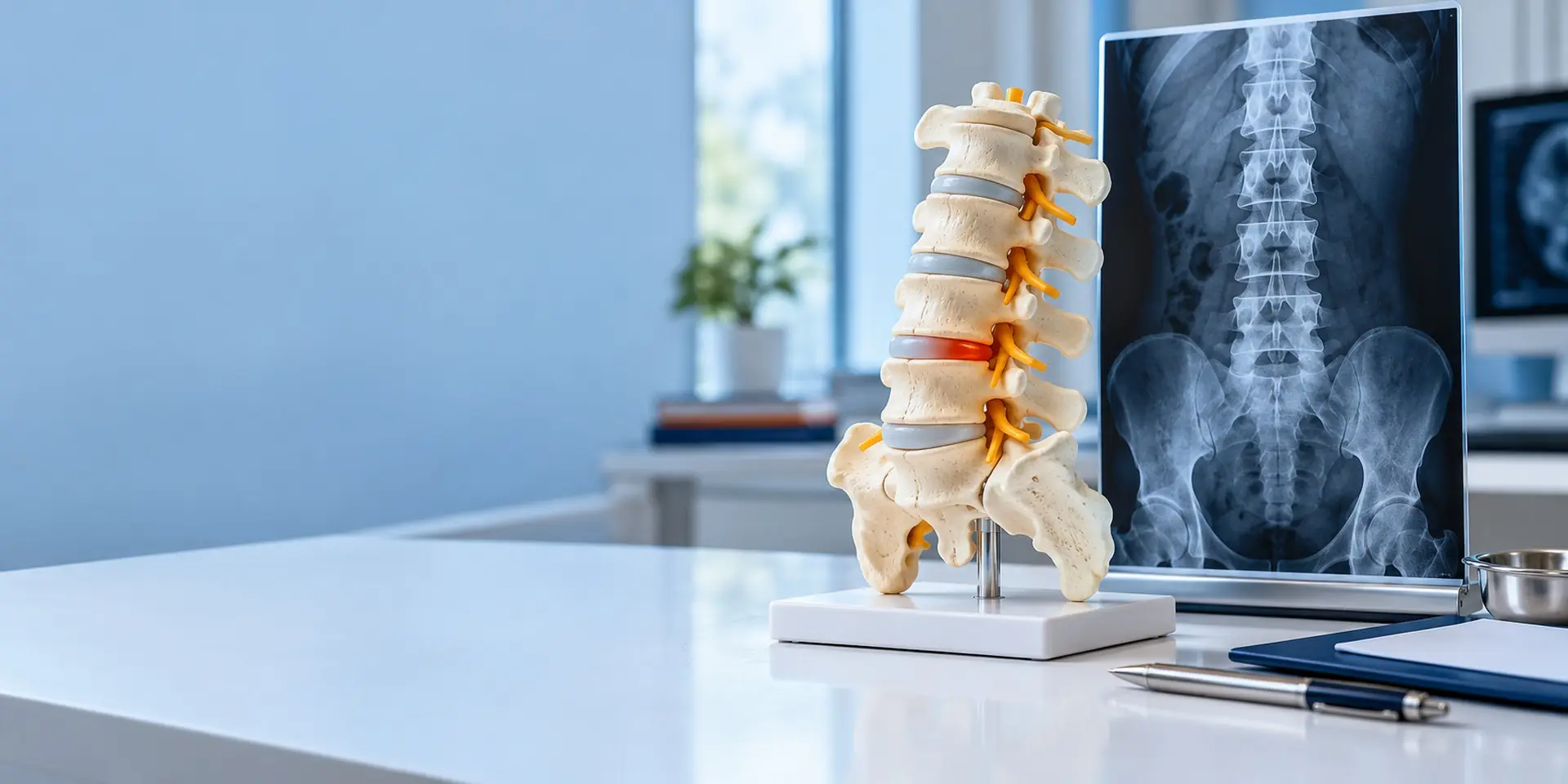
Lumbar disc prolapse: the back pain that runs down your leg.
A slipped (prolapsed) disc in your lower back presses on a nerve — and the nerve tells you about it, from your back all the way down your leg. Most settle without surgery. Our job is telling apart the ones that won't.
What a prolapsed disc is, and who gets one
Your discs are the rubbery cushions between the bones of your spine. A lumbar disc prolapse — also called a herniated or slipped disc — is when part of a disc in your lower back pushes out into the spinal canal, or into the opening where a nerve leaves the spine, and irritates or pinches that nerve. It is one of the commonest causes of low back pain and of leg pain (sciatica).
Most often it follows gradual, age-related wear of the disc — disc degeneration — and you may remember months of on-and-off low back pain before your leg pain started.
Who is most at risk. People with a sedentary lifestyle and weak lower-back muscles, desk workers, people who are overweight, smokers, those with a family history — and, at the other extreme, people in physically demanding jobs.
Symptoms
You feel intense low back pain with pain shooting down one leg — sciatica — often with tingling or numbness in a strip of your leg or foot. Coughing, sneezing and sitting tend to make it worse.
Weakness — a foot that slaps or catches — matters more than pain. And new problems passing urine or controlling your bowel, or numbness between your legs, are an emergency: come to us immediately.
Diagnosis
Your story and our examination map which nerve is unhappy. X-rays and an MRI scan confirm the prolapse when the picture would change your plan — persistent symptoms, significant weakness, or surgery on the table.
X-ray alone can't show a disc; we'll be straight with you about which imaging is worth doing and when.
Treatment options: conservative first, surgery for the few
Non-surgical treatment is our default, and it usually works. At Sun Hospitals we manage over 95% of lumbar disc prolapses without an operation: a short period of rest, medication, physiotherapy, changes to your daily activity and strengthening exercises. Most prolapses shrink and settle over weeks, and staying as active as your leg allows beats prolonged bed rest.
How quickly you improve depends on you, on how severe your prolapse was to begin with, and on how closely you follow your plan — but most people see improvement within 2 to 6 weeks.
Targeted injections can settle a screaming nerve while nature does its work. Surgery — removing the piece of disc pressing on your nerve — is for pain that persists beyond six weeks despite good conservative care, for progressive weakness, and urgently for cauda equina syndrome (numbness between the legs with bladder or bowel disturbance). Our dedicated spine surgeons do it after an honest conversation with you about what it fixes (leg pain) and what it may not (all back pain).
What to avoid while the pain is acute
While your nerve is inflamed, avoid sitting for long hours, sitting on the floor or on a soft sofa, lifting heavy weights, playing sport, and long road journeys. Your physiotherapist will tell you when each of these can come back.
And yoga? Many of our patients ask. Yoga is a very good form of exercise — but please don't do it during the acute stage. Once your pain has settled, ask your physiotherapist how and when to return to it.
Recovery timeline
Every recovery is different — we set your milestones, and your physiotherapist holds you to them.
FAQs
Do I need an MRI today?
What causes a disc to prolapse?
Who is most at risk?
How long before I feel better?
Is bed rest good for it?
Can I do yoga?
When does surgery come into it?
Will surgery fix my back pain?
Our team will usually see you within 24–48 hours of your request.
Book an appointment Get a second opinion